

Collectors sometimes wonder why a particular vehicle has never been produced as a scale model, especially when the subject appears popular or historically important.
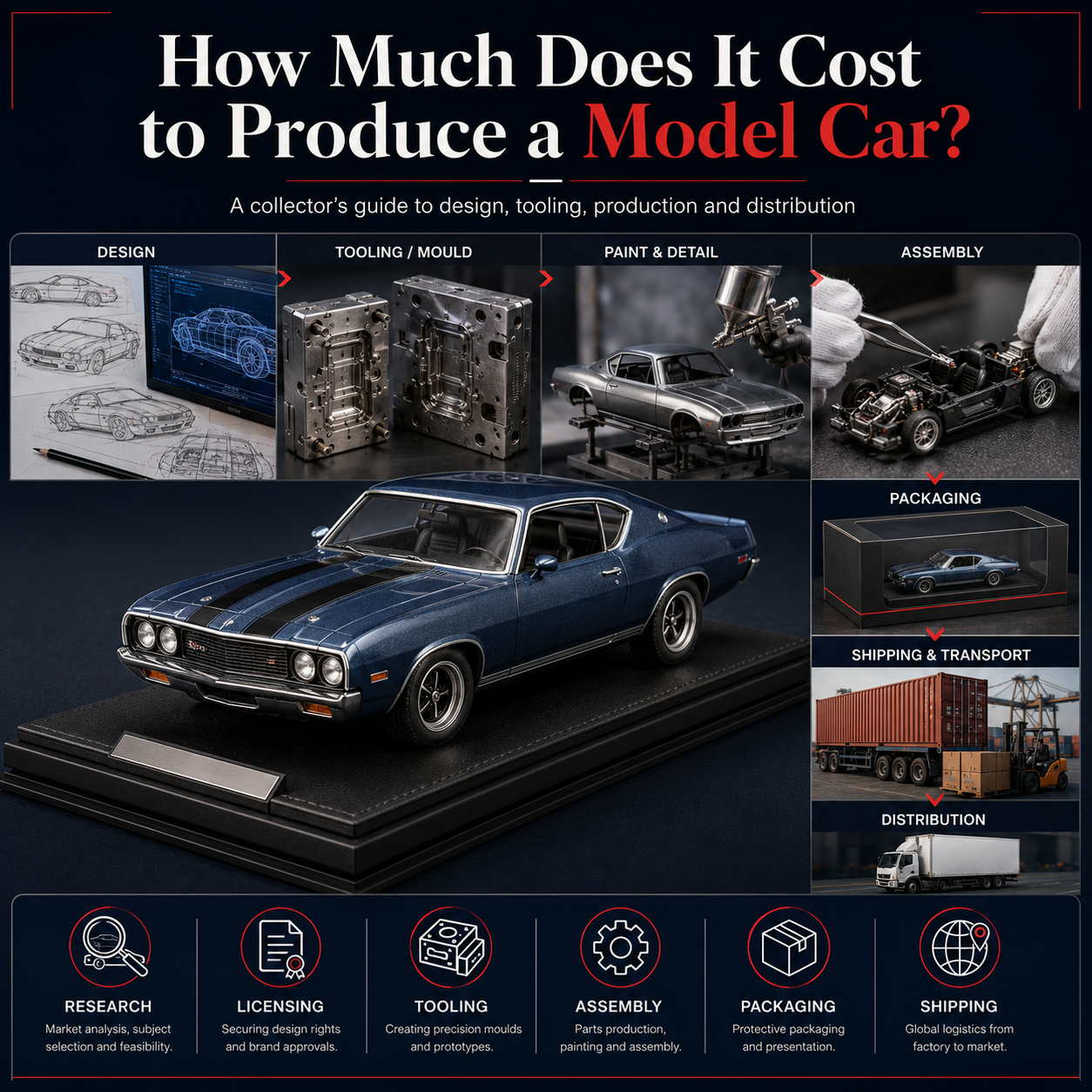
The answer often comes down to commercial viability. Producing a new diecast or resin model requires far more than creating a miniature body shape. Manufacturers may need to research the real vehicle, obtain licences, develop digital designs, produce prototypes, create tooling, arrange production, manufacture packaging and transport the finished models around the world.
Much of this investment must be committed before a single model is sold.
Important: There is no standard cost for producing a model car. The amount can vary greatly according to the scale, materials, complexity, production quantity, licensing requirements and manufacturing method.
Why Producing a New Model Is Expensive
A new model normally passes through several stages before it reaches collectors:
- Subject selection and commercial research
- Licensing and access to reference material
- Digital design and engineering
- Prototype production
- Tooling or mould creation
- Painting, printing and assembly
- Quality control
- Packaging production
- International shipping and distribution
- Retail marketing and customer support
Some costs are incurred once at the beginning of the project, while others apply to every model produced.
This distinction is important because a manufacturer needs to sell enough models to recover both the initial development investment and the cost of producing each individual unit.
Choosing the Subject
Before committing to production, a manufacturer must decide whether enough collectors are likely to buy the model.
They may consider:
- The popularity of the real vehicle
- The strength of the manufacturer or motorsport following
- Whether the subject has already been produced by competitors
- The likely selling price
- The preferred scale for that type of vehicle
- Demand in different international markets
- The availability and cost of licensing
- Whether several versions can use the same basic tooling
A vehicle can have a devoted enthusiast following without attracting enough worldwide demand to support a large production run.
This is one reason why well-known supercars, Formula One cars and popular classics are frequently reproduced, while less familiar family cars, commercial vehicles and regional models may be overlooked.
Research and Reference Material
An accurate scale model requires detailed information about the real vehicle.
The manufacturer may need:
- Technical drawings
- Factory dimensions
- Three-dimensional scan data
- Detailed photographs
- Paint specifications
- Interior and underside references
- Wheel and tyre measurements
- Racing livery artwork
Where possible, the design team may inspect or scan a real vehicle. Access can be difficult when the original car is rare, privately owned, located in another country or no longer exists in its original specification.
Incomplete reference material can increase development time and may limit how accurately certain details can be reproduced.
Licensing and Approvals
Most officially branded model vehicles require permission from the relevant rights holders.
Depending on the subject, approvals may be needed from:
- The vehicle manufacturer
- A motorsport team
- A racing championship
- A driver or their representatives
- Sponsors shown on the vehicle
- Film or television rights holders
Licensing arrangements may include fees, royalties, minimum production requirements and rules governing how the vehicle and trademarks are presented.
The approval process can also continue throughout development. Rights holders may review the prototype, colours, logos, packaging and promotional images before allowing the model to be released.
A complicated racing livery can be particularly demanding because several separate organisations may control the branding displayed on one car.
Digital Design and Engineering
Once sufficient reference material is available, the real vehicle must be converted into a design that can be manufactured at a much smaller scale.
This is not simply a matter of reducing every dimension equally. Some details may need to be strengthened, simplified or slightly exaggerated so that they remain visible and survive production.
The design team must consider:
- Body proportions
- Panel lines and shut lines
- Glazing thickness
- Interior components
- Wheels and tyres
- Mirrors, aerials and spoilers
- Chassis and underside detail
- Assembly points and securing screws
- Opening doors, bonnet or boot where included
A model with opening features generally requires more components and engineering than a sealed model.
Moving parts must fit correctly, remain aligned and withstand handling. Hinges, catches and panel gaps can make the development process considerably more complicated.
Prototype Development
Before full production begins, one or more prototypes are normally created.
These allow the manufacturer and licensor to assess:
- The overall shape and proportions
- Component fit
- Ride height and wheel position
- Interior accuracy
- Paint colours
- Decal placement
- Opening features
- Display base and packaging
Early samples may be produced using 3D printing, hand-built parts or temporary moulds.
If errors are found, the design may need to be changed and another prototype produced. Revisions add expense, but correcting problems at this stage is usually less costly than discovering them after full production has started.
Tooling for Diecast Models
Diecast models generally require hardened metal tools to form the body and other components.
Separate tooling may be required for:
- The main body shell
- Doors, bonnet and boot
- Chassis parts
- Interior components
- Wheels
- Glazing
- Lights and smaller plastic parts
Creating tooling can represent one of the largest initial costs in a diecast project. The tools must be precisely engineered and capable of producing consistent parts throughout the planned production run.
A detailed model with many separate components will usually require more tooling than a simpler sealed model.
Moulds for Resin Models
Resin models use a different production process and may not require the same expensive hardened tooling as traditional diecast models.
This can make resin suitable for smaller production quantities or more unusual subjects.
However, resin production still involves:
- Creating an accurate master model
- Producing casting moulds
- Casting individual components
- Cleaning and preparing each part
- Painting and assembly
- Replacing moulds as they wear
Resin models are often assembled and finished with a significant amount of manual work. Lower tooling costs therefore do not necessarily mean that the finished model will be inexpensive.
Diecast Versus Resin Production
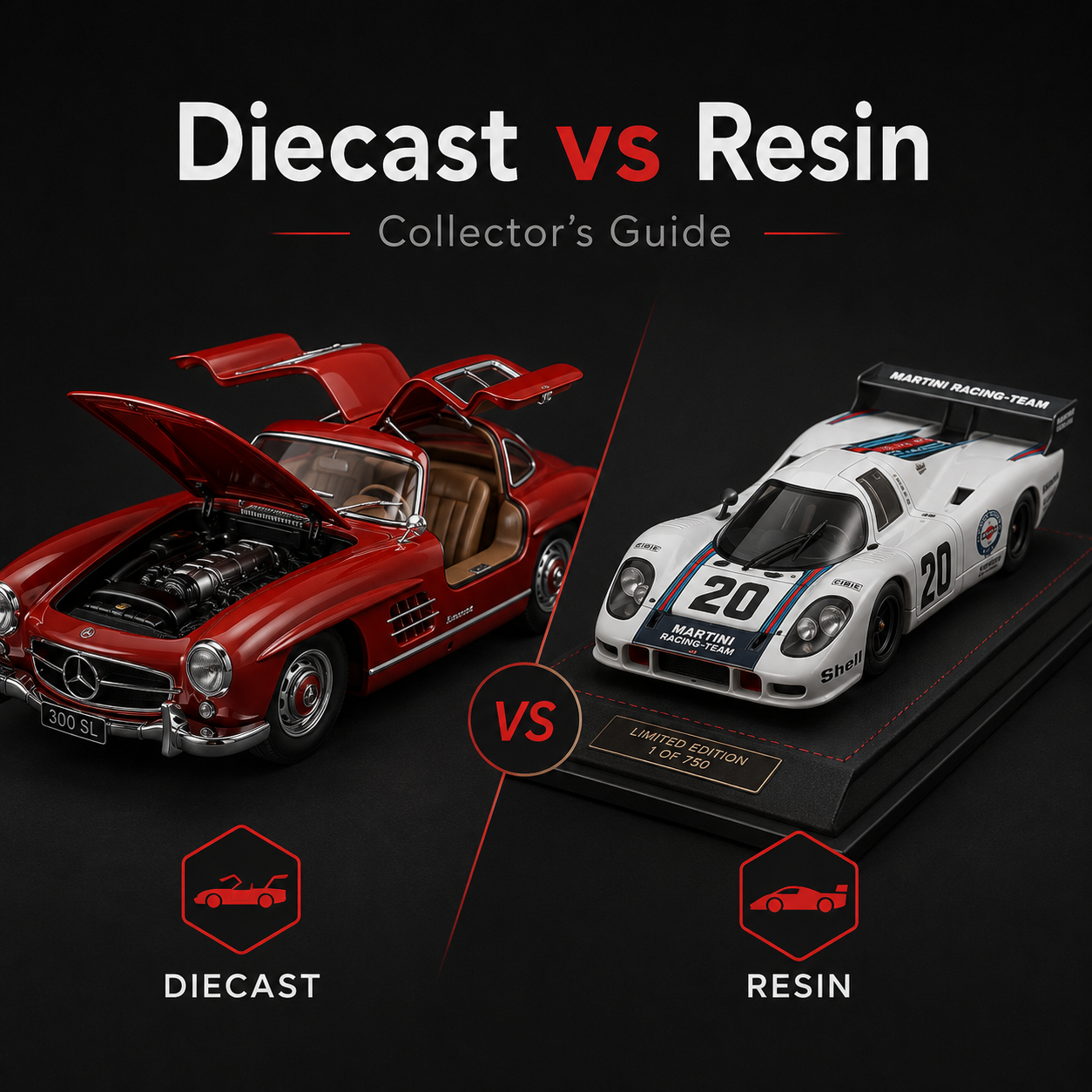
Neither material is universally cheaper or better. Each is suited to different types of production.
Diecast Production
Diecast manufacturing is often suitable for:
- Larger production quantities
- Models with opening features
- More robust construction
- Ranges intended for wider distribution
The initial tooling investment can be high, but the cost can be spread across a large number of models.
Resin Production
Resin manufacturing is often suitable for:
- Smaller production quantities
- Specialist or less mainstream subjects
- Complex body shapes
- Sealed collector models
- Models where exterior accuracy is prioritised
The ability to produce fewer units can help manufacturers offer subjects that might not justify full diecast tooling.
Number of Components
The number of separate parts has a major influence on manufacturing cost.
A relatively simple model may include a body, chassis, glazing, interior, wheels and a small number of external details.
A more complex collector model might also include:
- Separate door handles
- Photo-etched grilles
- Individual badges
- Detailed brake components
- Fabric-style seat belts
- Separate exhaust parts
- Engine components
- Working suspension
- Opening panels
- Multiple transparent light components
Every additional component must be designed, manufactured, painted where necessary, inspected and assembled.
Small parts can also increase the risk of production defects or transit damage.
Paint, Printing and Decals
The finishing process is another important part of the production cost.
A road car in a single colour may be relatively straightforward, although it can still require primer, colour coats, lacquer and printed details.
A motorsport model may need:
- Several paint colours
- Complex masking
- Large numbers of sponsor logos
- Driver names and flags
- Race numbers
- Tyre markings
- Small warning labels
- Detailed interior printing
Some liveries require a combination of paint, pad printing and waterslide decals. Accurate alignment can demand considerable manual skill.
Models with complicated liveries generally cost more to produce than plain road-car versions made from the same basic tooling.
Manual Assembly
Although production uses specialised equipment, many collector models still require extensive hand assembly.
Workers may need to:
- Fit glazing and interiors
- Attach wheels and axles
- Install mirrors and aerials
- Apply decals
- Fit photo-etched parts
- Secure the model to its display base
- Inspect and package the finished item
The greater the number of components and finishing stages, the more labour is required for each model.
This is one reason why two models of the same scale can have very different retail prices.
Quality Control and Rejected Models
Not every component or completed model will pass inspection.
Potential problems include:
- Paint blemishes
- Misaligned decals
- Cloudy glazing
- Incorrectly fitted parts
- Uneven wheels
- Glue marks
- Damaged mirrors or aerials
- Warped resin components
Defective models may need to be repaired, dismantled or rejected completely.
The cost of these failures must be absorbed within the overall production run, meaning the effective cost of each saleable model is higher than the cost of its individual materials.
Packaging and Presentation
Packaging must protect the model during international shipping, warehouse handling and final delivery to the collector.
Depending on the range, packaging may include:
- A printed outer box
- A window box
- A polystyrene or moulded plastic insert
- A display base
- An acrylic cover
- A protective sleeve
- A numbered certificate
- Instructions or accessories
Premium packaging can add significantly to the presentation and protection of a model, but it also increases production weight, storage requirements and shipping costs.
Packaging artwork may require separate design work and licensing approval.
Production Quantity
The number of models produced is one of the most important factors affecting the cost of each unit.
Initial expenses such as research, design, prototypes and tooling remain broadly similar whether the manufacturer produces a few hundred models or several thousand.
When more models are produced, these development costs can be spread across a larger number of units.
However, increasing production brings its own risks. If the manufacturer produces more models than collectors want, unsold stock may need to be discounted or stored for a long period.
The manufacturer must therefore balance:
- A production run large enough to recover the development costs
- A quantity small enough to avoid excessive unsold stock
- A retail price collectors are prepared to pay
Reusing Tooling
One of the most effective ways to make a project commercially viable is to use the same basic tooling for several releases.
A manufacturer may produce:
- Several colours of the same road car
- Different model years using shared components
- Road and racing versions
- Several racing liveries
- Different trim or wheel specifications
Each variation may still require new artwork, components or approvals, but the main body tooling does not need to be created again.
This helps explain why collectors sometimes see numerous versions of one vehicle while another similar car is never produced.
Shipping and Distribution
Most collectable models are manufactured some distance from the markets where they are sold.
The completed models may need to travel through:
- Factory transport
- Export handling
- Sea or air freight
- Customs clearance
- Importer or distributor warehouses
- Retailer delivery networks
Models are relatively bulky and fragile compared with many products of a similar value. Acrylic covers, display bases and protective packaging can make a shipment much larger than the models alone.
Freight, insurance, customs procedures and warehouse handling all contribute to the final cost.
Manufacturer, Distributor and Retailer Costs
The factory production cost is not the same as the retail selling price.
The price paid by the collector must support the businesses involved in bringing the model to market, potentially including:
- The manufacturer
- The licence holder
- The factory
- The importer
- The distributor
- The retailer
- Payment and marketplace providers
- Delivery companies
Retailers also incur costs associated with:
- VAT
- Card and payment fees
- Website operation
- Advertising
- Customer service
- Warehousing
- Protective delivery packaging
- Damaged or returned products
The difference between the factory cost and retail price is therefore not simply profit for one company.
Why Some Models Cost More Than Others
Two models in the same scale may have very different prices because of differences in:
- Production quantity
- Material
- Number of components
- Opening features
- Livery complexity
- Licensing costs
- Manual assembly
- Packaging quality
- Brand positioning
- Distribution arrangements
A sealed resin model can cost more than an opening diecast model if it is produced in a much smaller quantity or requires more specialist finishing.
Similarly, a mass-produced model with opening parts may remain relatively affordable because its development costs are spread across many units and variations.
Why Is There No Model of a Particular Car?
This is one of the most common questions asked by collectors.
A manufacturer may decide not to produce a model because:
- The expected demand is too low
- The licensing terms are unsuitable
- Accurate reference material is unavailable
- A suitable real vehicle cannot be accessed
- The tooling would be too expensive
- The subject appeals mainly to one small market
- A competing manufacturer already offers a similar model
- Too few variations could reuse the tooling
- The likely retail price would be higher than collectors would accept
The absence of a model does not necessarily mean that manufacturers are unaware of the vehicle. It may simply mean that the estimated sales do not justify the cost and risk.
Why Manufacturers Ask Retailers for Pre-Orders
Manufacturers and distributors sometimes announce models before production and ask retailers to submit advance orders.
This helps them assess:
- Overall market interest
- Demand in different countries
- The appropriate production quantity
- Whether the project is commercially viable
Strong pre-order demand can support the decision to proceed. Weak demand may lead to a smaller production run, a delayed project or, occasionally, cancellation.
Advance announcements are therefore part of the planning process rather than proof that the finished model already exists.
Does a Higher Price Always Mean Better Quality?
No. Price and quality are related, but they are not the same thing.
A higher price may reflect:
- A smaller production run
- Higher licensing costs
- Premium packaging
- More manual assembly
- A more complicated livery
- A specialist distribution arrangement
It does not guarantee that every detail or finish will be superior.
Collectors should consider the manufacturer, production method, features and price point rather than judging quality only by the retail price.
Frequently Asked Questions
How much does it cost to create a new model car?
There is no reliable single figure. Costs vary considerably according to the scale, production method, tooling, licensing, complexity and number of models produced.
Why are resin models often expensive?
Resin models are frequently produced in smaller quantities and may require substantial manual casting, preparation, painting and assembly. The development cost is therefore spread across fewer models.
Why can an inexpensive diecast model have opening parts?
Large production quantities and the reuse of tooling can reduce the cost per model, allowing some mass-market ranges to include opening features at accessible prices.
Why do manufacturers produce so many colours of the same car?
Alternative colours and specifications allow the manufacturer to reuse existing body tooling and spread the original development investment across more releases.
Can a retailer request that a manufacturer produces a particular model?
Retailers can pass on suggestions, but the final decision belongs to the manufacturer. A single retailer enquiry is unlikely to justify a new project without evidence of wider demand.
Why are some announced models cancelled?
A project may be cancelled because of licensing difficulties, production problems, rising costs or insufficient retailer orders.
Final Thoughts
Producing a new model car is a complex commercial project involving design, licensing, engineering, tooling, materials, skilled assembly, quality control, packaging and international distribution.
Manufacturers must invest considerable resources before knowing exactly how many collectors will buy the finished model. They therefore have to choose subjects that offer a realistic opportunity to recover those costs.
This explains why popular vehicles may appear in numerous colours and liveries, while more unusual subjects remain unavailable despite enthusiastic requests from collectors.
Understanding the production process also helps explain the differences in price between model ranges. The cost of a finished model reflects far more than the metal or resin used to create it.
Behind every scale model is a chain of research, design, manufacturing and distribution that brings a full-size vehicle into a collector’s display cabinet.

Share:
How Long Does It Take to Produce a Model Car?
How We Package Model Cars for Safe Delivery