

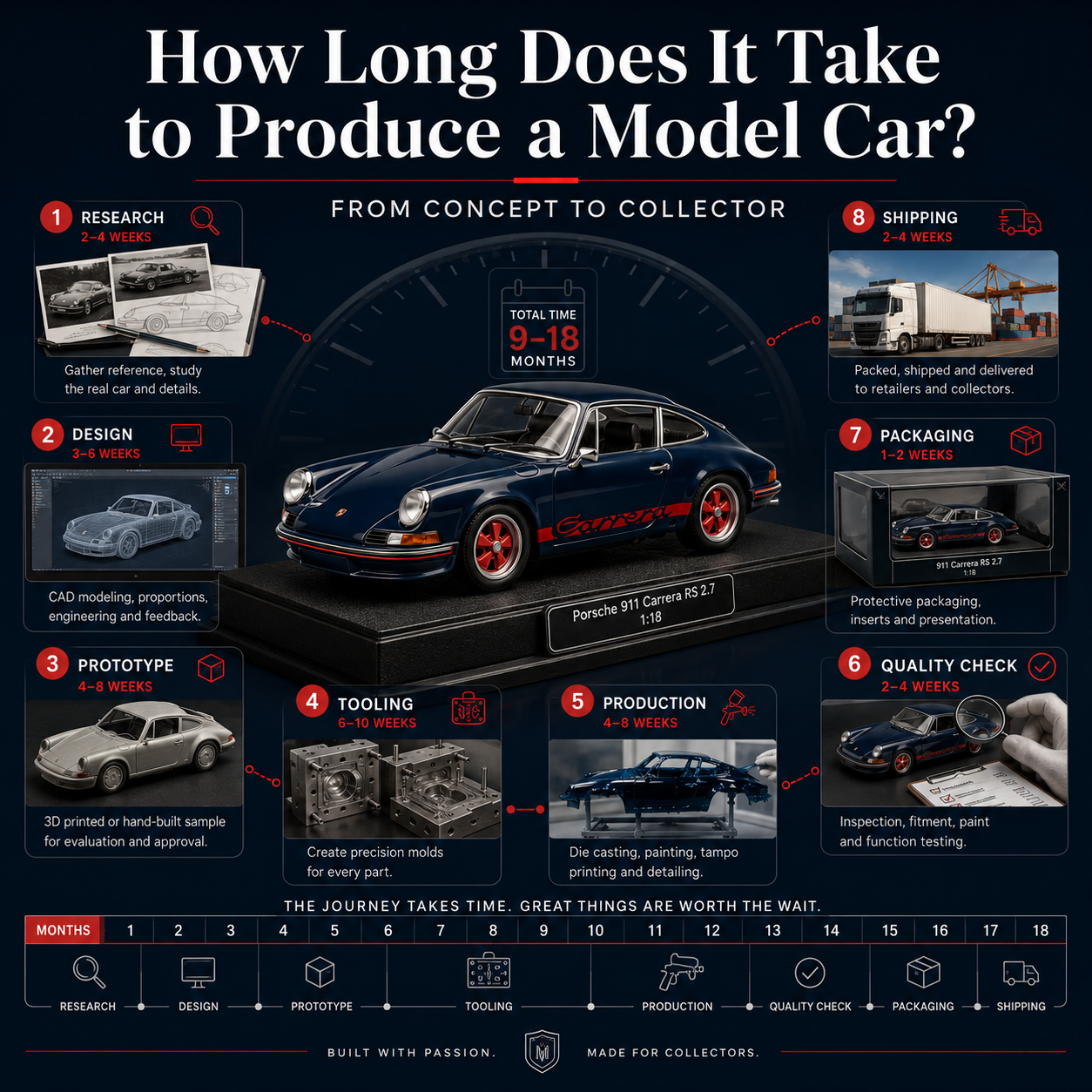
Producing a collectable diecast or resin model is a lengthy process involving research, design, licensing, engineering, tooling, production, quality control and international distribution.
Collectors may first see a model announced many months before it reaches retailers. In some cases, the finished release can take well over a year to move from the original idea to a display cabinet.
The exact timescale varies considerably. A straightforward colour variation based on existing tooling can be developed relatively quickly, while a completely new vehicle may require extensive research, new moulds, repeated prototypes and several rounds of approval.
Important: Model-development times are estimates rather than fixed schedules. Delays can occur at any stage, particularly during licensing, tooling, factory scheduling, quality control and international shipping.
How Long Does the Complete Process Take?
A completely new diecast or resin model can commonly take many months to develop and produce. More complex projects may take considerably longer.
The overall timescale depends on factors such as:
- Whether the model uses new or existing tooling
- The availability of accurate reference material
- The number of licences and approvals required
- The scale and level of detail
- Whether the model has opening features
- The complexity of the paintwork or racing livery
- The production quantity
- Factory capacity
- Quality-control results
- Shipping and distribution arrangements
The stages may also overlap. Packaging artwork might be developed while tooling is being tested, for example, but one unresolved issue can still prevent the whole project from progressing.
Stage 1: Choosing the Subject
The process begins with deciding which vehicle to reproduce.
Manufacturers may consider:
- Collector demand
- The popularity of the real vehicle
- Competition from existing models
- Licensing availability
- Expected production costs
- Potential colour and livery variations
- Demand across different countries
- The likely retail price
A manufacturer may announce a subject early to gauge interest from distributors and retailers. This can happen before the final design or production schedule has been confirmed.
Strong advance demand may help a project proceed, while weak retailer orders can lead to reduced production, postponement or cancellation.
Stage 2: Research and Reference Gathering
Before an accurate design can be created, the development team needs detailed information about the real vehicle.
This may include:
- Factory drawings and dimensions
- Three-dimensional scan data
- Detailed exterior photographs
- Interior and dashboard images
- Wheel and tyre specifications
- Paint references
- Underside and engine details
- Historic racing photographs
- Sponsor and livery artwork
Access to the real vehicle can save time, but it is not always possible. Historic racing cars may have been modified, restored incorrectly, destroyed or held in private collections.
Where the available information is incomplete, additional research may be required before design work can continue.
Stage 3: Licensing and Initial Approval
Official models normally require permission from the organisations that own the vehicle design, brand names and other intellectual property.
Approvals may be needed from:
- The vehicle manufacturer
- A motorsport team
- A championship organiser
- A driver or their representatives
- Sponsors
- Film or television rights holders
The manufacturer may need to submit the proposed subject, scale, specification, packaging and sales territory before development can proceed.
Road cars can require several approval stages, while racing models may involve numerous separate logos and rights holders. Waiting for feedback or negotiating changes can add significant time.
Stage 4: Digital Design and Engineering
Once sufficient reference information is available, designers create a digital three-dimensional model of the vehicle.
This stage involves more than reducing the real car to a smaller size. The design must also be suitable for manufacture.
The team must consider:
- Body proportions
- Panel and shut lines
- Glazing thickness
- Interior construction
- Wheel size and position
- Mirrors, spoilers and aerials
- Chassis and underside components
- How the parts will fit together
- How the model will attach to its base
Some real-world details are too thin or fragile to reproduce exactly at scale. They may need to be strengthened or slightly enlarged so that they can survive production and handling.
Stage 5: Prototype Production
A prototype allows the manufacturer and licence holder to assess the design before committing to full production.
Early samples may be made using:
- 3D-printed components
- Hand-finished master patterns
- Temporary moulds
- Prototype tooling
- Parts adapted from existing models
The prototype is checked for:
- Overall shape and proportions
- Ride height and stance
- Wheel and tyre appearance
- Interior detail
- Component fit
- Opening features
- Paint colours
- Decal and logo placement
Corrections are common at this stage. A roofline may need adjusting, wheels may sit incorrectly or certain details may be difficult to manufacture as originally designed.
Each major revision can require the design to be updated and another sample produced.
Stage 6: Tooling and Mould Creation
Once the design is approved, production tooling or moulds can be created.
Diecast Models
Diecast models normally require precision metal tooling for the body and other components.
Separate tools may be needed for:
- The main body shell
- Doors, bonnet and boot
- Chassis components
- Interior parts
- Wheels
- Glazing
- Lights and trim
The more parts and opening features a model has, the more complicated this stage becomes.
Resin Models
Resin production often uses master patterns and casting moulds rather than heavy diecast tooling.
This can make resin more suitable for smaller production runs, but the moulds may wear more quickly and many parts require considerable manual preparation.
Tooling and mould development can be one of the longest stages because faults may only become apparent when test components are produced.
Stage 7: Tool Testing and Engineering Samples
The first parts made from production tooling are normally assembled into test samples.
These samples allow the manufacturer to identify problems such as:
- Poorly fitting components
- Distorted body panels
- Uneven panel gaps
- Weak hinges
- Incorrect wheel alignment
- Cloudy or poorly fitting glazing
- Parts that are difficult to assemble
Tooling may need to be modified several times before the manufacturer is satisfied.
A small change to one component can also affect several adjoining parts, so apparently minor corrections can take longer than expected.
Stage 8: Colour and Decoration Samples
After the physical construction has been approved, the manufacturer normally produces painted and decorated samples.
These may include:
- The final exterior colour
- Interior colours
- Printed badges and trim
- Racing numbers
- Sponsor logos
- Tyre markings
- Display-base labels
- Packaging artwork
Matching the real vehicle’s colour can be difficult, especially where historic photographs show different shades or the original paint is no longer available.
Racing liveries can take longer because each decal must fit the scaled body accurately and may require approval from several rights holders.
Stage 9: Final Approval
The decorated sample is usually submitted for final approval before full production.
The licence holder may request changes to:
- Body details
- Paint colour
- Logos and trademarks
- Driver names
- Packaging text
- Promotional photographs
Production may not be allowed to begin until these corrections have been completed and approved.
This stage can be unpredictable because manufacturers do not control how quickly every separate rights holder responds.
Stage 10: Factory Scheduling and Material Preparation
Most model brands work with specialist factories producing items for several manufacturers.
Once approval is complete, the project must be allocated a production period.
The factory also needs to arrange:
- Metal, resin and plastic materials
- Paints and coatings
- Decals and printed components
- Tyres and wheels
- Photo-etched parts
- Display bases
- Acrylic covers
- Packaging materials
If the project misses its reserved factory slot because approval or tooling is late, another slot may not be immediately available.
This can turn a short development delay into a much longer change to the expected release date.
Stage 11: Component Production
Full production begins with the manufacture of the individual model components.
For diecast models, molten metal is injected into the body tooling. Plastic parts may be injection moulded separately.
For resin models, components are cast from liquid resin and then removed from their moulds.
Components may then require:
- Trimming
- Cleaning
- Sanding
- Drilling
- Surface preparation
- Inspection
Rejected parts must be replaced before the model can move to painting and assembly.
Stage 12: Painting and Decoration
The body and other components are painted before final assembly.
Depending on the model, this may involve:
- Primer
- Several colour coats
- Masking
- Lacquer
- Pad printing
- Waterslide decals
- Hand-painted details
A simple road-car colour can be relatively straightforward, whereas a complex motorsport livery may require numerous separate stages.
Each painted or printed component needs time to dry or cure before the next process begins.
Stage 13: Hand Assembly
Many collector models require a substantial amount of manual assembly.
Workers may fit:
- Interiors and dashboards
- Glazing
- Wheels and tyres
- Lights
- Mirrors and aerials
- Exhaust components
- Photo-etched grilles
- Spoilers and wings
- Opening panels
The model may then be secured to a display base and prepared for inspection.
Complex models take longer to assemble and may experience a higher rate of damaged or incorrectly fitted parts.
Stage 14: Quality Control
Quality checks may take place throughout production as well as after final assembly.
Inspectors may check:
- Paint consistency
- Decal alignment
- Panel fit
- Wheel alignment
- Glazing clarity
- Missing or loose parts
- Opening features
- Packaging condition
Some defects can be corrected, while others require the model or component to be rejected.
If a repeated fault is found across a large number of models, production may be paused while the cause is investigated.
Stage 15: Packaging
The completed model must be packaged securely enough to survive transport from the factory to the collector.
Packaging may include:
- A display base
- An acrylic cover
- A moulded insert
- Polystyrene protection
- A window box
- A printed outer carton
- A protective sleeve
- A numbered certificate
The packaging itself must be designed, printed, assembled and approved.
A completed model can therefore still be delayed if its boxes, bases or protective inserts are not ready.
Stage 16: International Shipping
Most models still have a lengthy journey after leaving the factory.
This may include:
- Transport from the factory to the port
- Export customs procedures
- Container loading
- Sea or air freight
- Port handling
- Import customs clearance
- Transport to the distributor
Sea freight can take several weeks and may be affected by port congestion, weather, route changes or customs inspections.
Stock may also reach different countries at different times, which explains why collectors sometimes see a model available overseas before it arrives in the United Kingdom.
Stage 17: Distribution to Retailers
Once stock reaches the distributor, it must be received, counted and allocated to retailers.
The distributor may need to:
- Inspect the shipment
- Confirm retailer allocations
- Separate different products
- Prepare invoices
- Arrange domestic delivery
If only part of the expected production run arrives, retailers may receive their allocations in more than one batch.
New Tooling Versus an Existing Model Variation
Not every release takes the same amount of time.
Completely New Tooling
A model of a vehicle that has not previously been produced by the manufacturer requires the full development process, including new digital design, prototypes and tooling.
This normally takes the longest.
New Colour or Road-Car Specification
A different colour based on an existing model can often be developed more quickly because the body and most components already exist.
However, colour samples, packaging and licensing may still require approval.
New Racing Livery
A racing version may reuse the main tooling but require extensive artwork and sponsor approvals.
A complex livery can therefore still take a considerable amount of time even when the underlying model already exists.
Why Production Dates Change
Manufacturers often announce expected release periods before every stage is complete.
A delay can occur because:
- Reference information is incomplete
- The licensor requests changes
- A prototype reveals inaccuracies
- Tooling needs adjustment
- A factory slot is missed
- Materials or components arrive late
- Quality-control faults are discovered
- Packaging is delayed
- The shipment is held at a port or customs
The effect can be cumulative. A project that is delayed during approval may then lose its factory slot, which delays production and changes the planned shipping schedule.
Can a Model Be Produced More Quickly?
Some projects can move faster, particularly when:
- The manufacturer already has suitable tooling
- The vehicle requires only a new colour
- Licensing approval is straightforward
- The production run is relatively simple
- The factory has available capacity
- Existing packaging can be adapted
However, speeding up production can increase the risk of mistakes. Collectors generally benefit when manufacturers allow enough time for accurate design and proper quality control.
Why Are Models Announced So Early?
Early announcements allow manufacturers and distributors to measure demand before production.
Retailer orders can help determine:
- Whether the project should proceed
- The size of the production run
- Which countries require stock
- Whether additional versions are viable
An early announcement does not necessarily mean that the model is already being manufactured. It may still be at the research, design or approval stage.
Frequently Asked Questions
How long does it take to make a new model car?
A completely new model can take many months and may require well over a year where the design, tooling or licensing is particularly complex.
Why can a new colour be released more quickly?
The manufacturer can reuse the existing body tooling and most components, although new paint samples, packaging and approvals may still be required.
Does resin production take less time than diecast production?
Not necessarily. Resin models may require less expensive tooling, but casting, preparation, painting and assembly can involve substantial manual work.
Why does a model take so long after the prototype is shown?
The prototype may still require approval, tooling changes, colour development, factory scheduling, mass production, quality control and international shipping.
Can retailers speed up production?
No. Retailers do not control the manufacturer, factory, licensing process or shipping schedule.
Why is the same model already available in another country?
Different markets often receive separate shipments and distributor allocations. Stock can therefore arrive in one country before another.
Final Thoughts
Producing a collectable model is a combination of automotive research, digital design, engineering, skilled manufacturing and detailed finishing.
Every release must pass through numerous stages before it reaches a retailer. A problem with one small component, approval or shipment can affect the whole schedule.
This helps explain why models are often announced long before they become available and why estimated release dates sometimes change.
Although the wait can be frustrating, careful development gives manufacturers the opportunity to correct inaccuracies, improve component fit and address quality problems before the finished model reaches collectors.
Behind every model in a display cabinet is a lengthy process that turns a full-size vehicle into a detailed miniature collectable.

Share:
How to Have a Custom Model Car Made: A Collector’s Guide
How Much Does It Cost to Produce a Model Car?