

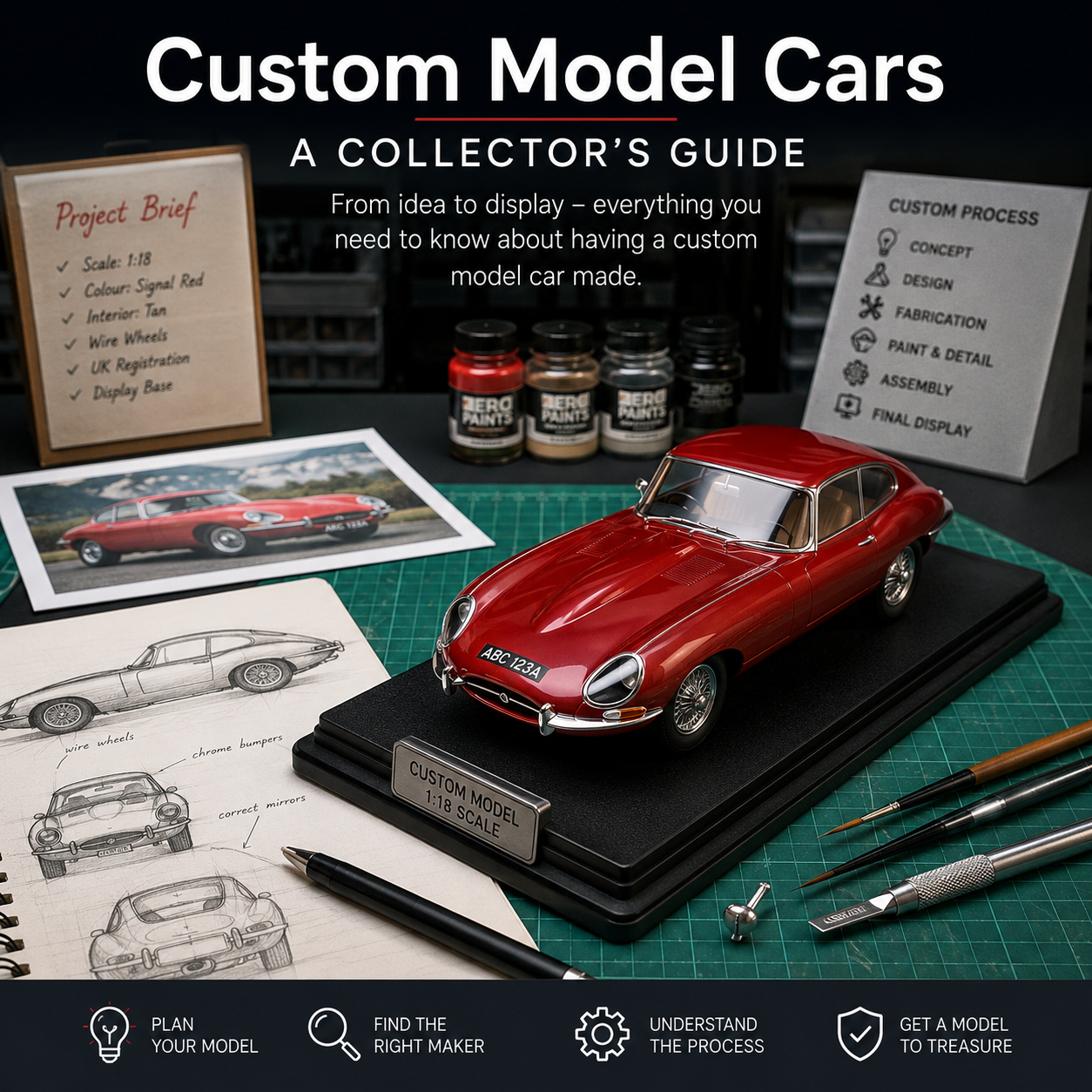
For many collectors, the ultimate model is not necessarily a famous racing car or limited-edition supercar. It may be a replica of their own vehicle, a treasured family car, a former competition car or a vehicle connected to a special memory.
When no ready-made model is available, commissioning a custom model may provide a solution. However, bespoke model making can be a complex process involving research, design, specialist craftsmanship and considerable patience.
This guide explains the main options available, what information you may need to provide, how to assess a model maker and what to agree before work begins.
Important: Diecast Model Centre is a retailer of ready-made collectable models. We do not produce, modify or commission custom models, and we cannot recommend individual model makers or help customers find someone to undertake a project.
What Is a Custom Model?
A custom model is a miniature vehicle produced or modified to match a particular real vehicle or specification.
This could include:
- A replica of your current or former car
- A model of a family member’s vehicle
- A particular registration number or colour combination
- A racing car with a specific livery
- A modified road car
- A vehicle that has never been produced as a ready-made collectable
- A conversion of an existing model into another version
The amount of work required depends heavily on whether a suitable base model already exists.
Start by Checking Whether a Model Already Exists
Before commissioning a completely bespoke model, search carefully for an existing model of the vehicle.
Model manufacturers have produced an enormous variety of cars over the years, including unusual colours, limited-production vehicles, racing liveries and regional variations. A discontinued model may also be available through specialist retailers, collectors’ fairs or the pre-owned market.
If a model exists in approximately the right specification, it may be considerably easier and less expensive for a specialist to modify it than to create the entire vehicle from scratch.
Choose the Type of Custom Model
There are several ways in which a custom model can be produced.
Modified Donor Model
A donor model is an existing ready-made model used as the starting point for the project.
The model maker may change:
- Paint colour
- Wheels and tyres
- Registration plates
- Interior colours
- Badges and trim
- Decals or racing liveries
- Lights, mirrors or other exterior details
This is often the most practical option when the correct make and body style already exist.
Conversion
A conversion involves making more substantial alterations to an existing model.
Examples might include changing a road car into a competition version, recreating a different body style or adding parts that were not included on the original donor model.
Conversions may require cutting, reshaping, filling, fabrication and repainting. The complexity will depend on how different the required vehicle is from the donor model.
Scratch-Built Model
A scratch-built model is created largely or completely from individual materials rather than being based on an existing production model.
This method may be required when no suitable donor model exists. It can involve extensive research and highly specialised work, particularly where the model includes a detailed interior, chassis or engine.
Scratch-built models are normally among the most time-consuming and expensive forms of custom model making.
3D-Printed Model
Digital design and 3D printing have made it possible to produce subjects that would previously have been extremely difficult to recreate.
A maker may design and print:
- A complete body
- Replacement wheels
- Interior components
- Badges and trim
- Conversion parts
- Display accessories
Resin printing is commonly used where small details and smooth surfaces are important. Filament printing may be used for larger structural parts, prototypes or components that require greater strength.
Printing is only one stage of the process. A collector-quality model may still require cleaning, curing, sanding, filling, priming, painting, decal application and final assembly.
The quality of the finished model therefore depends on the design and finishing work as much as the printing technology itself.
Decide on the Scale
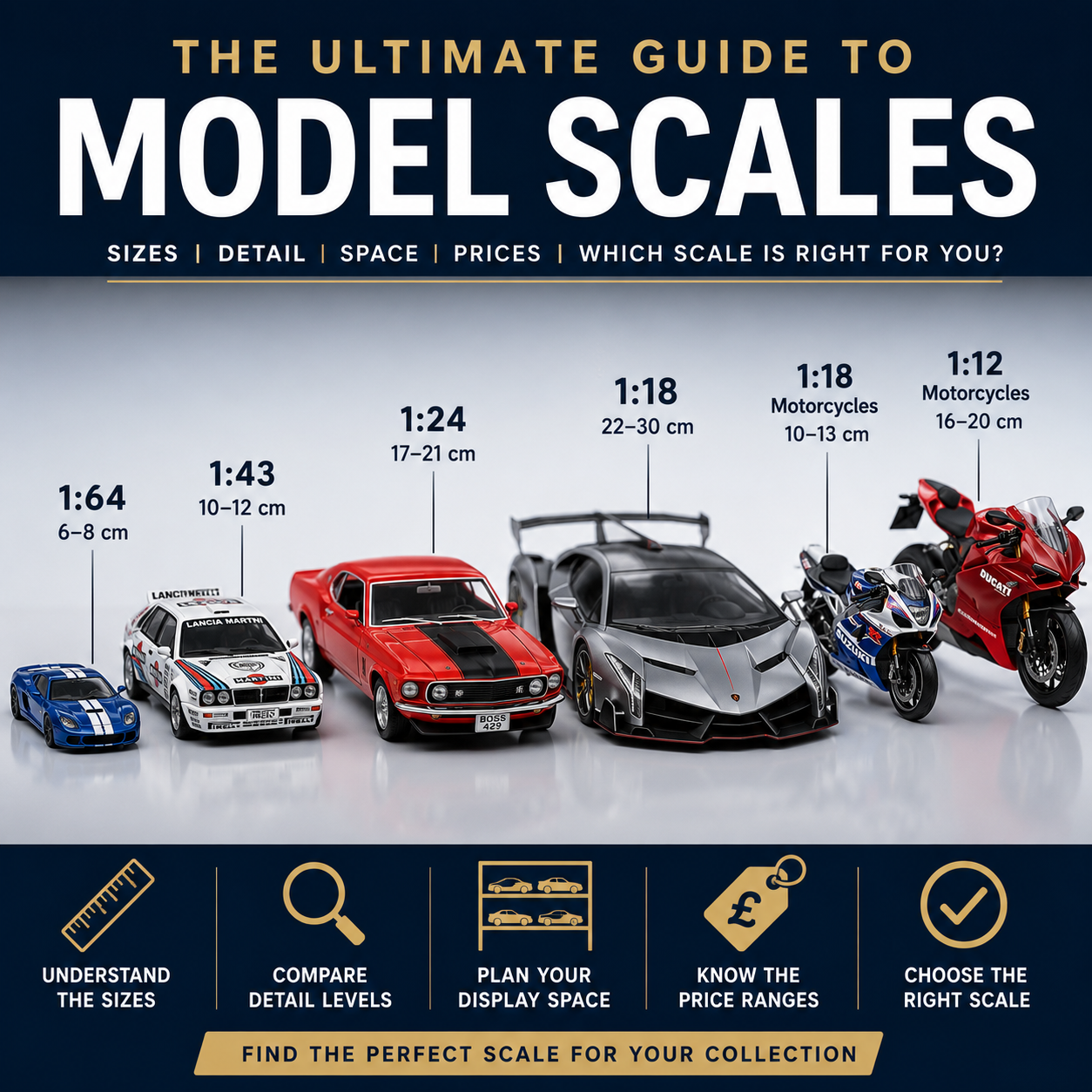
The scale affects the size, detail, cost and display requirements of the finished model.
Common car model scales include:
- 1:64 scale: Compact and space-efficient, but very small details can be difficult to reproduce.
- 1:43 scale: A popular collector scale offering a good balance between size and visible detail.
- 1:24 scale: Larger and easier to display as an individual piece without requiring as much room as a 1:18 model.
- 1:18 scale: Provides strong display presence and greater scope for detailed interiors and mechanical components.
A larger scale does not automatically guarantee a better result. The most suitable choice depends on the available reference material, the maker’s experience and the amount of detail required.
It may also be sensible to choose a scale that matches the rest of your collection.
Define Exactly What You Want
Before contacting a model maker, prepare a clear description of the required vehicle.
Include as much of the following information as possible:
- Manufacturer and model
- Year or generation
- Body style
- Exact exterior colour
- Interior colour and trim
- Wheel design
- Registration number
- Badges and model designation
- Optional equipment
- Aftermarket modifications
- Racing number, sponsors or livery details
- Your preferred model scale
Minor differences that seem unimportant at the beginning can become very noticeable on the finished model. It is better to identify them before work starts.
Gather Good Reference Material
A model maker can only reproduce details that can be seen or accurately described.
Whenever possible, provide clear photographs showing:
- Front and rear views
- Both sides of the vehicle
- Front and rear three-quarter views
- Wheels and tyres
- Dashboard and seats
- Badges and registration plates
- Any unusual accessories or modifications
Photographs taken in natural daylight are particularly useful for showing paint colour and trim.
For a vehicle that no longer exists, family photographs, sales brochures, magazine features, workshop manuals and historic images may all help. However, incomplete references may require the maker to make reasonable assumptions about details that cannot be confirmed.
Finding a Suitable Model Maker
Custom model makers often specialise in particular scales, materials or types of work. Someone experienced in repainting 1:18 road cars may not necessarily be the best choice for a completely scratch-built 1:43 commercial vehicle.
When considering a maker, look for:
- A portfolio showing similar completed projects
- Clear and detailed photographs of previous work
- Independent customer feedback
- Experience with your chosen scale and production method
- Clear communication
- Written prices and payment terms
- Realistic timescales
- Appropriate packaging and delivery arrangements
Pay particular attention to close-up photographs. These may reveal the quality of paintwork, decals, panel lines, glazing, wheels and smaller finishing details.
Questions to Ask Before Commissioning the Model
Before paying a deposit or approving the project, establish exactly what is included.
Useful questions include:
- Will the model be based on an existing donor model?
- Who will supply the donor model?
- Which parts will be changed or produced?
- Will the model have opening parts?
- Will the wheels rotate or steer?
- Will the interior be fully detailed?
- Will a display base or case be included?
- How many design revisions are included?
- Will progress photographs be provided?
- What deposit is required?
- When will the remaining payment become due?
- What happens if the project cannot be completed?
- Who is responsible if the donor model is damaged during conversion?
- How will the finished model be packaged and insured?
A detailed written agreement reduces the risk of misunderstandings later.
Understanding the Cost
There is no standard price for a custom model. Costs can vary considerably depending on:
- The scale
- The availability of a suitable donor model
- The amount of research required
- The complexity of the conversion
- The number of specially made parts
- The quality of the paint and finishing
- The interior detail
- The need for custom decals or artwork
- Whether digital design work is required
- The inclusion of a display base or cover
- Packaging, insurance and delivery
A relatively simple colour change and registration plate alteration may cost far less than a scratch-built model. However, even apparently straightforward work can require many hours of careful preparation and finishing.
Ask for a written quotation that clearly explains what is included. It is also sensible to establish whether changes requested after approval will result in additional charges.
Allow Plenty of Time
Custom models should not normally be treated as quick purchases.
The process may include:
- Initial discussion
- Research and reference gathering
- Finding or purchasing a donor model
- Digital design or fabrication
- Approval of colours and specifications
- Production and finishing
- Final inspection
- Packaging and delivery
Established makers may also have a queue of existing commissions.
Projects involving scratch building, extensive body alterations or several specially produced parts can take considerably longer than a repaint or minor conversion.
If the model is intended for a birthday, anniversary or Christmas present, begin enquiries as early as possible. Do not assume that a project can be rushed to meet a fixed date.
Reviewing and Approving the Design
Depending on the production method, the maker may provide sketches, digital renderings, colour samples or photographs of the donor model before starting.
Check the proposed specification carefully, including:
- Body colour
- Interior colour
- Wheels
- Registration plates
- Badges
- Decal positioning
- Vehicle stance and ride height
- Display base wording
Once formal approval has been given, changes may be difficult or expensive. This is particularly important if parts have already been printed, the model has been painted or custom decals have been produced.
Following the Production Process
Agree in advance how often you will receive updates.
Progress photographs may be provided after important stages such as:
- Preparation of the donor model
- Body modification
- Completion of printed components
- Priming
- Painting
- Decal application
- Final assembly
Regular updates can be reassuring, but excessive messages may interrupt the maker’s work. A sensible update schedule should be agreed at the beginning.
Inspecting the Finished Model
Before the model is despatched, request clear final photographs where possible.
Check the finished model against the agreed specification, paying particular attention to:
- Paint colour and finish
- Alignment of decals and registration plates
- Wheels and ride height
- Interior details
- Mirrors, aerials and other delicate parts
- Display base wording
- Any specially requested features
A handmade model may not have exactly the same uniformity as a mass-produced factory model. However, the expected finish and any limitations should have been explained before the commission was accepted.
Delivery and Packaging
Custom models can be particularly vulnerable during transit, especially if they include delicate mirrors, aerials, wings or photo-etched components.
Confirm:
- How the model will be secured
- Whether it will be attached to a display base
- Whether the parcel will be insured
- Who is responsible for transit damage
- Whether collection is available
Keep the packaging after delivery. A bespoke model may be difficult to transport safely without its original packing materials.
Displaying and Caring for a Custom Model
A display case can protect the model from dust, accidental contact and handling damage.
For long-term care:
- Keep the model away from prolonged direct sunlight
- Avoid excessive heat, cold and humidity
- Handle it by the base or strongest parts
- Do not lift it by mirrors, spoilers or aerials
- Use a soft brush or suitable air blower to remove light dust
- Avoid household cleaning chemicals
- Retain the original packaging and project documentation
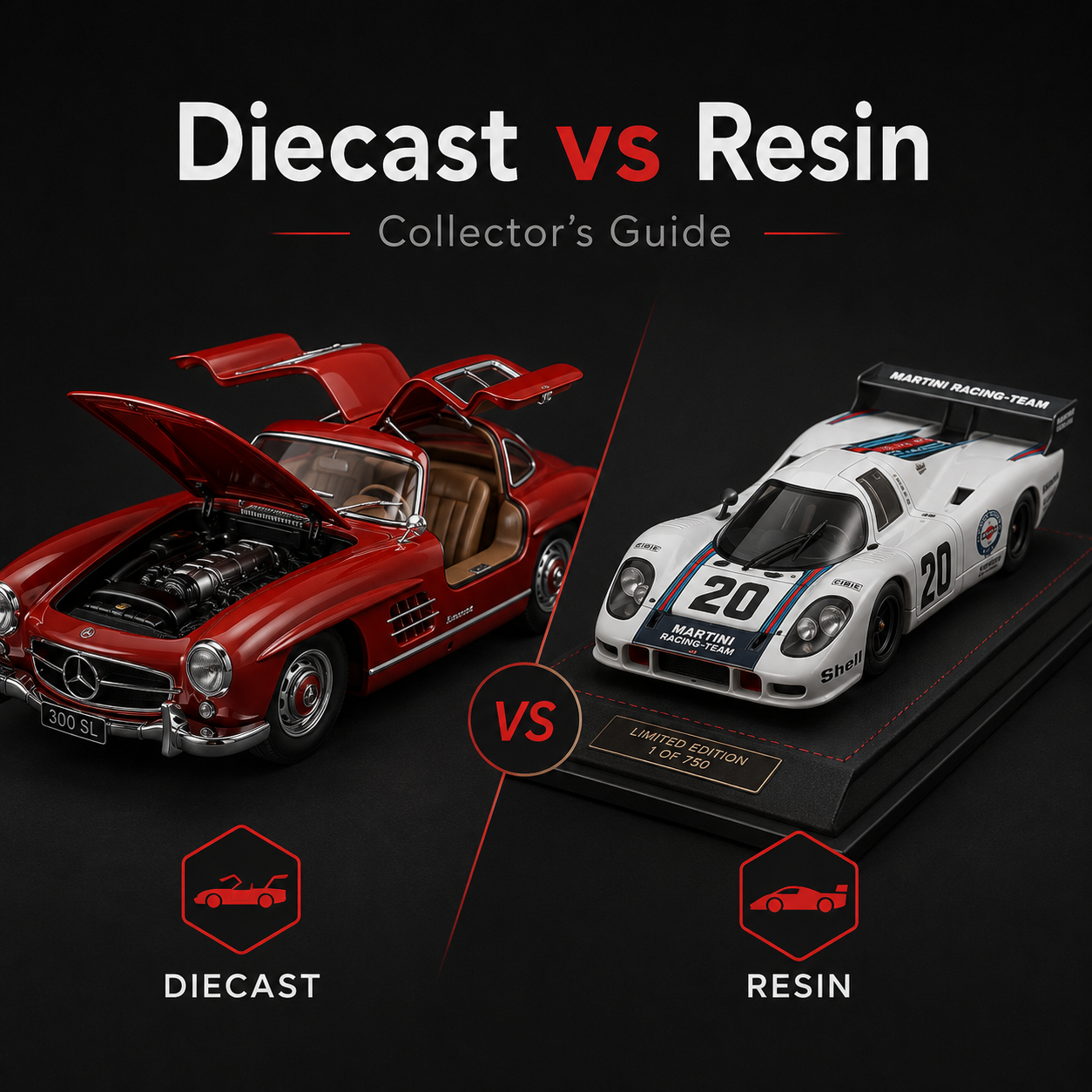
Resin and 3D-printed parts may be more fragile than traditional diecast components, particularly where sections are thin or highly detailed.
Warning Signs to Look Out For
Exercise caution if a prospective maker:
- Cannot provide examples of previous work
- Uses photographs belonging to other makers
- Will not provide a written quotation
- Promises an unusually fast completion time
- Requests full payment without explaining the project terms
- Provides vague answers about materials or production methods
- Refuses to discuss what happens if the project cannot be completed
Custom work often requires trust, particularly when a valuable donor model is being supplied. Take time to research the maker before making a payment or sending any model to them.
Final Thoughts
Commissioning a custom model can be a rewarding way to recreate a vehicle with personal or historic importance. The most successful projects usually begin with clear expectations, good reference material and a model maker whose skills match the work required.
Before proceeding, decide exactly what you want, understand the proposed production method and obtain a clear written quotation. Allow generous time for the work and carefully review the specification before giving approval.
A well-made custom model can become a unique centrepiece within a collection, but it should be approached as a specialist commission rather than a standard retail purchase.
Please note: Diecast Model Centre does not manufacture, modify, source or commission custom-made models. We are also unable to recommend model makers or provide assistance in finding a suitable specialist. This independent guide has been created in response to the custom-model enquiries we regularly receive.
Share:
Why Are New Model Releases Available Overseas Before the UK?
How Long Does It Take to Produce a Model Car?