


Introduction
One of the first questions every collector faces is simple:
What scale should I collect?
Whether you are buying your first model or adding to a collection built over many years, understanding scale is essential. The scale you choose affects everything from display space and detail levels to cost, storage requirements and the overall appearance of your collection.
Many collectors begin by purchasing models they like, only to discover later that mixing scales can create challenges when displaying models together. Others quickly run out of shelf space because they underestimate how much room larger models require. Choosing the right scale from the outset can help you build a collection that remains enjoyable, practical and visually consistent for years to come.
The good news is that there is no right or wrong answer. Some collectors prefer the impressive presence and fine detail of larger 1:18 scale models. Others enjoy building extensive collections of 1:64 models that allow dozens of vehicles to be displayed in the space required for just a handful of larger pieces.
In this guide, we explain:
-
What model scale means
-
How the major collector scales compare
-
Physical size differences
-
Detail expectations
-
Display space requirements
-
Which scales suit different collectors
-
Popular brands within each scale
-
How to choose the right scale for your collection
By the end, you should have a clear understanding of which scale best suits your available space, budget and collecting goals.
Scale at a Glance
| Scale | Typical Length | Detail Level | Display Space | Typical Price Range |
|---|---|---|---|---|
| 1:64 Cars | 6–8 cm | Good | Excellent | £8–£30 |
| 1:43 Cars | 10–12 cm | Very Good | Very Good | £20–£120 |
| 1:24 Cars | 17–21 cm | Good–Very Good | Moderate | £15–£60 |
| 1:18 Cars | 22–30 cm | Excellent | High | £50–£250+ |
| 1:18 Motorcycles | 10–13 cm | Good | Excellent | £8–£20 |
| 1:12 Motorcycles | 16–20 cm | Excellent | Moderate | £15–£50+ |
Quick Recommendations
Choose 1:64 If You:
-
Have limited display space
-
Want a large collection
-
Enjoy modern performance cars
-
Like building dioramas
Choose 1:43 If You:
-
Want the best balance of size and detail
-
Collect Formula One, rally or motorsport models
-
Want efficient use of display space
Choose 1:24 If You:
-
Want larger models at accessible prices
-
Are buying gifts
-
Prefer visible detail without premium pricing
Choose 1:18 If You:
-
Want maximum detail
-
Enjoy display centrepieces
-
Have dedicated display space
Choose 1:18 Motorcycles If You:
-
Want affordable motorcycle collecting
-
Have limited shelf space
-
Enjoy building larger collections
Choose 1:12 Motorcycles If You:
-
Prioritise mechanical detail
-
Want premium display pieces
-
Collect racing or road motorcycles
What Does Scale Mean?
Scale describes the relationship between a model and the real vehicle.
A 1:18 scale model means the real vehicle has been reduced to one eighteenth of its original size.
A 1:43 scale model means the real vehicle has been reduced to one forty-third of its original size.
The smaller the second number, the larger the model itself becomes.
For example:
| Scale | Relative Size |
|---|---|
| 1:64 | Small |
| 1:43 | Medium |
| 1:24 | Medium-Large |
| 1:18 | Large |
| 1:12 | Very Large |
Understanding scale allows collectors to build displays that look consistent and make the best use of available space.
Why Scale Matters
Scale affects nearly every aspect of collecting:
-
Detail levels
-
Display space
-
Storage requirements
-
Packaging size
-
Price range
-
Collection consistency
-
Visual impact
-
Portability
A collector displaying twenty 1:64 models may require less space than someone displaying five 1:18 models.
Likewise, a collector seeking highly detailed interiors, engines and mechanical components will often prefer larger scales.
Understanding Physical Size Differences
The table below uses a typical road car as an example.
| Scale | Approximate Length |
|---|---|
| 1:64 | 6–8 cm |
| 1:43 | 10–12 cm |
| 1:24 | 17–21 cm |
| 1:18 | 22–30 cm |
Motorcycles differ slightly due to their proportions:
| Scale | Approximate Length |
|---|---|
| 1:18 Motorcycle | 10–13 cm |
| 1:12 Motorcycle | 16–20 cm |
Actual dimensions vary depending on the subject. A Formula One car, racing motorcycle, bus, truck or tractor may differ significantly from these averages.
How Big Is Each Scale?
One of the biggest surprises for new collectors is just how different model scales can feel in person.
A 1:18 model is not simply a slightly larger version of a 1:43 model. Larger scales offer greater presence and detail, but they also require significantly more display space.
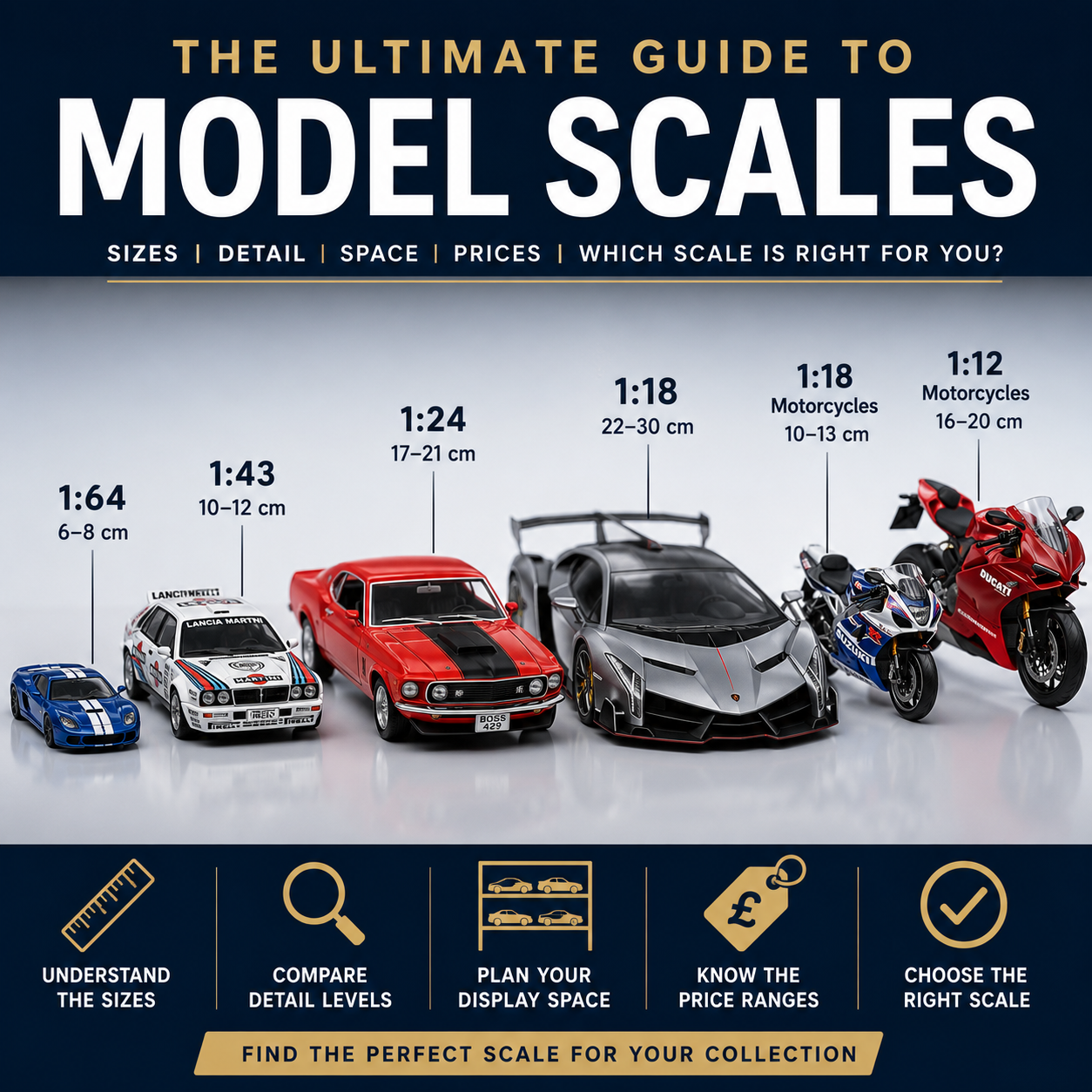
The examples below use approximate average model lengths to compare the most popular collector scales. Actual dimensions vary depending on the vehicle being modelled, but the comparison provides a useful indication of relative size.
Car Scale Comparison

1:18 Scale Car
Typical shelf capacity: 4–5 models per metre
Best for: Maximum detail, premium collections and display centrepieces.

1:24 Scale Car
Typical shelf capacity: 6–8 models per metre
Best for: Larger models at accessible prices.

1:43 Scale Car
Typical shelf capacity: 8–10 models per metre
Best for: The ideal balance of detail and practicality.

1:64 Scale Car
Typical shelf capacity: 15–20+ models per metre
Best for: Large collections and limited display space.
Motorcycle Scale Comparison

1:12 Scale Motorcycle
Typical shelf capacity: 6–8 models per metre
Best for: Premium motorcycle collections and maximum visible detail.

1:18 Scale Motorcycle
Typical shelf capacity: 10–15 models per metre
Best for: Affordable motorcycle collecting and compact displays.
Sizes and shelf capacities are approximate. Actual dimensions vary depending on the real vehicle, model manufacturer and display method.
1:64 Scale Models
Overview
1:64 has experienced enormous growth in recent years. Once viewed primarily as a toy scale, modern brands now produce highly detailed collector-focused models that appeal to enthusiasts of all ages.
For many collectors, it offers the perfect balance between affordability and display efficiency.
Best For
-
Limited display space
-
Large collections
-
Modern performance cars
-
Japanese tuning culture
-
Diorama displays
Advantages
-
Extremely space efficient
-
Affordable entry point
-
Huge range of subjects available
-
Easy to expand collections
Considerations
-
Smaller details can be harder to appreciate
-
Interiors are often simplified
-
Most models are sealed
Popular Brands
1:43 Scale Models
Overview
For decades, 1:43 has been regarded as the traditional collector scale and remains one of the most popular worldwide.
It offers one of the strongest balances between realism, detail, affordability and practicality.
Best For
-
Mixed vehicle collections
-
Collectors wanting balance
Advantages
-
Excellent size-to-detail ratio
-
Large variety of subjects
-
Efficient use of display space
-
Strong manufacturer support
Considerations
-
Limited opening features
-
Smaller interior visibility
Popular Brands
1:24 Scale Models
Overview
1:24 remains one of the most recognised scales among enthusiasts and gift buyers.
It provides larger models without the cost and space requirements associated with premium 1:18 collections.
Best For
-
Gift purchases
-
Casual collectors
-
Larger displays on a budget
Advantages
-
Strong shelf presence
-
Affordable pricing
-
Often includes opening parts
Considerations
-
Less detailed than premium 1:18 models
-
Smaller range of specialist subjects
Popular Brands
1:18 Scale Models
Overview
1:18 is widely regarded as the premium collector scale.
These larger models offer exceptional display presence and often showcase remarkable levels of detail.
Typical Features
Many diecast examples include:
-
Opening doors
-
Opening bonnet
-
Opening boot
-
Detailed engines
-
Steering mechanisms
-
Realistic interiors
-
Brake and suspension detail
Premium resin models often prioritise exterior accuracy over opening functionality.
Best For
-
Dedicated collectors
-
Showcase displays
-
Premium collections
-
Supercar enthusiasts
Advantages
-
Outstanding realism
-
Exceptional detail
-
Strong visual impact
-
Impressive display presence
Considerations
-
Requires substantial display space
-
Higher average prices
-
Larger storage requirements
Popular Brands
Motorcycle Model Scales
Unlike model cars, motorcycle collecting is primarily centred around two scales: 1:18 and 1:12.
Each offers a different balance between display space, detail and affordability.
1:18 Motorcycle Models
Overview
1:18 motorcycles are among the most popular scales for collectors seeking an affordable and space-efficient way to build a large collection.
While smaller than their 1:12 counterparts, modern examples still capture the character and styling of the original motorcycle extremely well.
Best For
-
Collectors with limited display space
-
Building larger collections
- Racing motorcycle collectors
-
Gift purchases
-
Casual motorcycle enthusiasts
Advantages
-
Affordable pricing
-
Easy to display in quantity
-
Wide variety available
-
Excellent value
Considerations
-
Smaller mechanical details
-
Simplified construction compared to 1:12 models
Popular Brands
1:12 Motorcycle Models
Overview
1:12 is widely regarded as the premium motorcycle collector scale.
The larger size allows manufacturers to reproduce exposed mechanical components with significantly greater accuracy.
Engines, frames, suspension systems, exhausts and braking systems become much easier to appreciate.
Best For
-
Dedicated motorcycle enthusiasts
-
Display centrepieces
-
Collectors seeking maximum realism
Advantages
-
Outstanding mechanical detail
-
Excellent display presence
-
Realistic proportions
-
Easier to appreciate individual components
Considerations
-
Requires more display space
-
Usually costs more than 1:18 motorcycles
-
Delicate mirrors and handlebars require careful handling
Popular Brands
Which Motorcycle Scale Should You Choose?
| If You Want... | Recommended Scale |
|---|---|
| Maximum detail | 1:12 |
| Best value | 1:18 |
| Large collections | 1:18 |
| Display centrepieces | 1:12 |
| Limited shelf space | 1:18 |
| Mechanical realism | 1:12 |
Choosing a Scale Based on Your Collecting Style
The Formula One Collector
Recommended Scale:
1:43
Large choice of historic and modern Formula One models with excellent livery detail and efficient display requirements.
The Supercar Collector
Recommended Scales:
1:18 or 1:64
1:18 provides impressive display pieces.
1:64 allows extensive collections without requiring large display cabinets.
The Classic Car Collector
Recommended Scale:
1:43
Excellent subject availability covering many decades and manufacturers.
The Motorcycle Collector
Recommended Scales:
1:18 or 1:12
Choose 1:18 for affordability and collection size.
Choose 1:12 for detail and display impact.
The Collector With Limited Space
Recommended Scales:
1:64 or 1:43
These scales provide the best balance between collection size and shelf space.
Display Cabinet Considerations
One of the most overlooked aspects of collecting is long-term display planning.
Before committing to a scale, consider:
-
Shelf depth
-
Cabinet height
-
Dust protection
-
Sunlight exposure
-
Future expansion
Approximate shelf capacity per metre:
| Scale | Models Per Metre |
|---|---|
| 1:18 Cars | 4–5 |
| 1:24 Cars | 6–8 |
| 1:43 Cars | 8–10 |
| 1:64 Cars | 15–20+ |
| 1:18 Motorcycles | 10–15 |
| 1:12 Motorcycles | 6–8 |
Many collections grow much faster than expected.
How Much Display Space Will You Need?
One of the most common mistakes new collectors make is underestimating how quickly a collection can grow.
The illustration below shows approximately how many models can fit on a typical one-metre shelf. Actual capacity varies depending on vehicle type and display method, but it provides a useful comparison between scales.

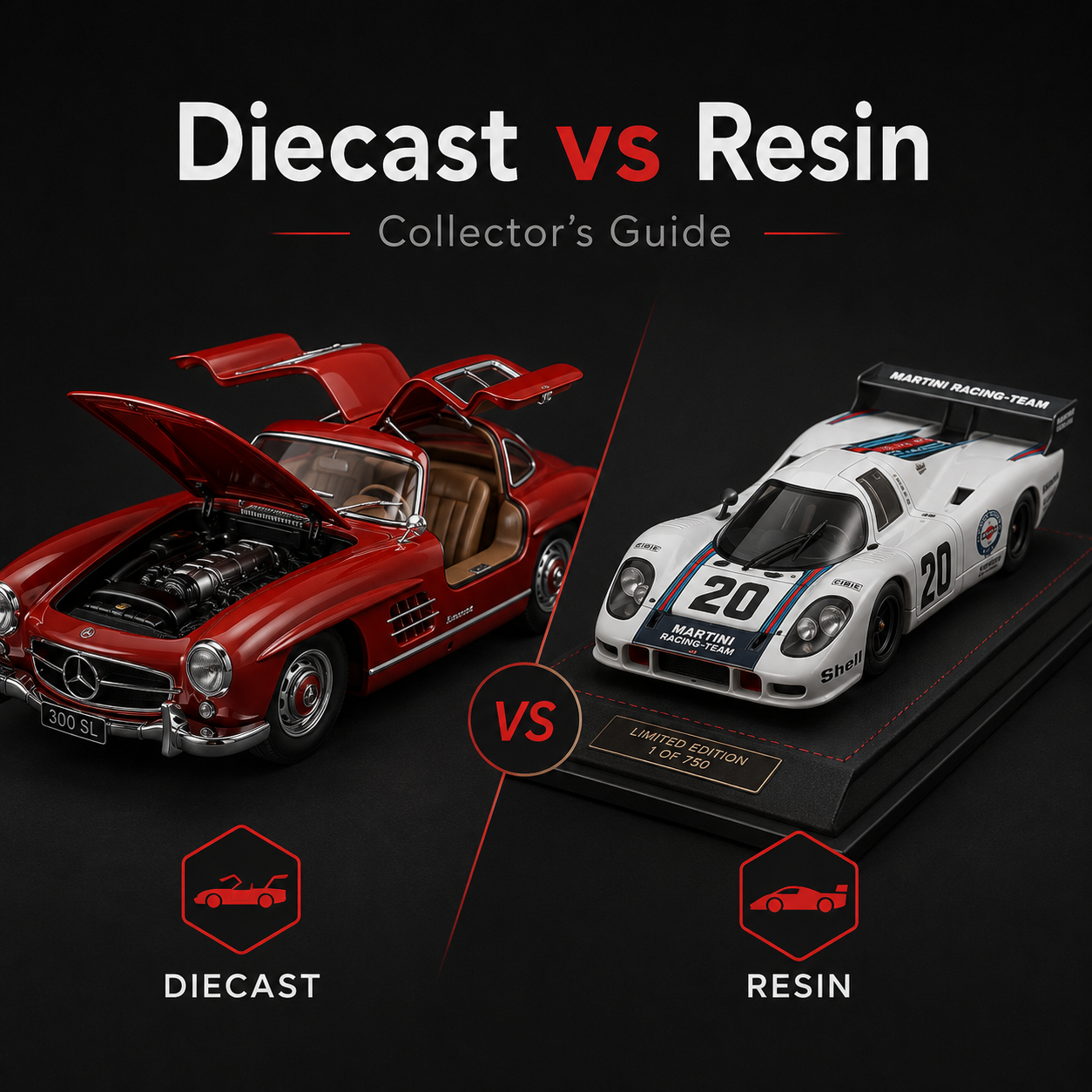
Diecast vs Resin Models
Both diecast and resin models appear across multiple scales.
Diecast Models
Typically:
-
Heavier
-
More durable
-
More likely to feature opening parts
-
Better suited to regular handling
Resin Models
Typically:
-
Produced in smaller quantities
-
More accurate body shapes
-
Sealed construction
-
More fragile
Today, many premium 1:18 and 1:43 collector models are produced in resin to maximise exterior accuracy.
Neither material is inherently better. The best choice depends on what matters most to you as a collector.
Frequently Asked Questions
Which scale is most popular?
Historically, 1:43 dominated the collector market. Today, 1:64, 1:43 and 1:18 are among the most popular scales worldwide.
Which scale offers the most detail?
Generally, 1:18 cars and 1:12 motorcycles offer the highest levels of detail.
What is the best scale for beginners?
1:43, 1:64 and 1:18 motorcycles are excellent starting points due to their affordability and display efficiency.
Can I mix scales in my collection?
Absolutely. Many collectors display different scales separately by category or subject.
Are resin models better than diecast?
Not necessarily. Resin often offers superior exterior accuracy, while diecast models usually provide opening features and greater durability.
Which scale takes up the least space?
1:64 for cars and 1:18 for motorcycles.
Why are some resin models more expensive?
Many resin models are produced in limited quantities and focus heavily on accuracy and exclusivity.
Final Thoughts
The best scale is the one that fits your:
-
Available space
-
Budget
-
Display preferences
-
Favourite vehicle types
-
Long-term collecting goals
Some collectors focus on a single scale for consistency, while others collect multiple scales depending on the vehicles that interest them most.
There is no universally correct choice.
Whether you prefer compact 1:64 collections, versatile 1:43 displays, impressive 1:18 centrepieces or highly detailed 1:12 motorcycles, understanding scale will help you build a collection that remains enjoyable, practical and rewarding for years to come.
After all, collecting is not simply about owning models. It is about creating a display that reflects your interests, passions and appreciation for automotive history.

Share:
How to Protect Your Parcels from Doorstep Theft
Diecast vs Resin Models: A Collector’s Guide