

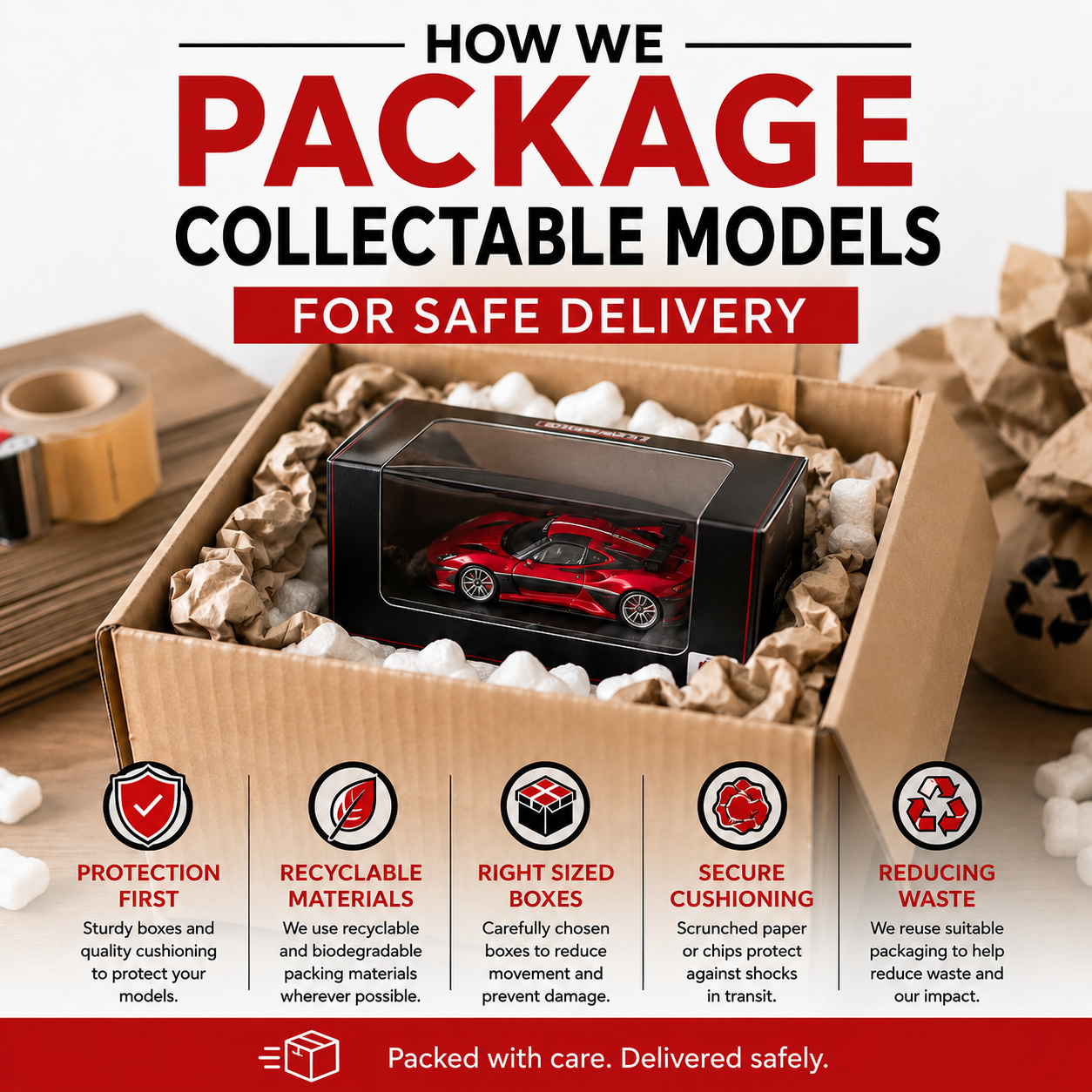
Collectable model cars can be surprisingly vulnerable during delivery. Mirrors, aerials, spoilers, display covers and outer packaging can all be damaged if the model is not packed carefully.
The manufacturer’s box provides some protection, but it is primarily designed to present and store the model. It is not always strong enough to protect the contents from every impact, drop or compression that may occur within a delivery network.
For this reason, suitable outer packaging, cushioning and careful box selection are essential when sending diecast and resin models.
Our Priority
Every order is packed to protect both the model and its presentation packaging while avoiding unnecessary materials and oversized parcels.
Why Model Cars Need Careful Packaging
Scale models differ considerably from ordinary household products. Even a robust diecast model may include delicate plastic, resin or photo-etched components.
Potentially vulnerable areas include:
- Wing mirrors and aerials
- Spoilers and racing wings
- Bonnet ornaments
- Exhausts and suspension parts
- Resin body components
- Acrylic display covers
- Printed sleeves and collector boxes
The retail packaging may also be important to a collector. A crushed corner, torn sleeve or heavily marked window box can reduce the enjoyment and potential resale appeal of an otherwise undamaged model.
What Packaging Must Protect Against
A parcel can experience several types of movement during transit.
These may include:
- Impacts caused by sorting and handling
- Pressure from other parcels
- Movement inside the shipping box
- Vibration during transport
- Drops from conveyor belts or vehicles
- Moisture and poor weather
Good packaging cannot remove every risk, but it should reduce movement, absorb shocks and prevent the model’s own packaging from coming into direct contact with the outer box.
Choosing the Right Outer Box
The shipping box must be strong enough for the weight and size of the order.
A box that is too small may leave insufficient room for protective material. This can allow an impact to transfer directly through the cardboard and into the model packaging.
A box that is unnecessarily large can create different problems:
- The contents may move more easily
- More void fill is required
- The parcel becomes less efficient to transport
- Material and delivery costs can increase
The aim is to select a box that provides enough clearance for effective cushioning without leaving excessive empty space.
Why a Tightly Fitting Box Is Not Always Safer
A model may appear secure when it fits very closely inside a shipping box, but minimal clearance can reduce protection.
If the outer box is struck or compressed, the force can be transferred directly to the model’s retail packaging.
A slightly larger box with suitable cushioning may provide better protection because the packing material creates a buffer around the contents.
This is especially important for:
- Models supplied in acrylic display cases
- Large 1:18 scale models
- Resin models with delicate details
- Orders containing several differently sized items
- Models with valuable presentation packaging
Cushioning and Void Fill
Cushioning helps prevent movement and absorbs some of the shock caused by handling.
Depending on the size and type of order, suitable materials may include:
- Scrunched packing paper
- Biodegradable packing chips
- Reused bubble wrap
- Reused air pillows
- Corrugated cardboard inserts
The important point is not simply to fill the box. The material should support the item and prevent it from shifting when the parcel is moved.
Overfilling can also be harmful. Excessive pressure may crush the retail box, damage an acrylic cover or distort lightweight packaging.
Using Packing Paper
Scrunched packing paper can provide effective protection when used correctly.
It can be placed:
- Under the model to create a cushioning layer
- Around the sides to prevent movement
- Between multiple models
- Above the contents before the box is closed
The paper should be loosely scrunched rather than tightly compressed into hard shapes. This allows it to absorb movement rather than transmitting force directly to the item.
Using Packing Chips
Biodegradable packing chips are useful for filling irregular spaces and surrounding awkwardly shaped packaging.
They are particularly helpful when:
- The model box does not match the shape of the shipping carton
- Several products are packed together
- Additional support is needed around corners
- A lightweight item needs to be held centrally
Packing chips should be distributed evenly so that the contents remain supported on all sides.
Protecting Multiple Models
Orders containing several models require additional planning.
The items should not be allowed to strike or rub against one another during transit. Heavier models should also not rest directly on lighter boxes or acrylic covers.
Where appropriate, models may be separated using:
- Layers of cardboard
- Packing paper
- Bubble wrap
- Individual protective sections
The overall weight of the parcel must also be considered when choosing the strength of the outer box.
Does the Model Need to Stay Upright?
Collectors often expect a model to remain upright during transport, but parcel carriers cannot guarantee the orientation of a box throughout its journey.
A parcel may be placed on its side, turned over or stacked during sorting and delivery.
Packaging should therefore protect the model in every likely orientation rather than relying on “this way up” markings alone.
Models secured to their manufacturer’s display bases are generally designed to remain fixed within their packaging. However, the outer box must still prevent excessive movement and compression.
Protecting Acrylic Covers and Display Cases
Many premium 1:43 and resin models are supplied on a display base with a clear acrylic cover.
These covers can be vulnerable to:
- Cracking
- Scratching
- Pressure damage
- Movement against the outer box
They should not be placed directly against the walls of a shipping carton. A cushioning layer around the retail packaging helps reduce the risk of impact damage.
Protecting the Manufacturer’s Box
For many collectors, the original box forms part of the product.
Our packaging approach is intended to protect:
- The model itself
- The display base or cover
- The window box
- The printed sleeve
- The branded outer carton
Some budget model ranges may arrive from the manufacturer with minor box marks or shelf wear, but the delivery packaging should prevent avoidable additional damage during despatch.
Our Packaging Approach
At Diecast Model Centre, every order is packed in a cardboard shipping box rather than being sent in a basic mailing bag.
We select the box and protective materials according to:
- The size and weight of the model
- The type of manufacturer packaging
- Whether the model is diecast or resin
- The presence of an acrylic display cover
- The number of items in the order
- The amount of cushioning required
Orders may be protected using scrunched packing paper, biodegradable packing chips or suitable reused protective materials.
The exact combination will vary because a small 1:64 model does not require the same packaging arrangement as a heavy 1:18 model or a large multi-item order.
Reusing Packaging Materials
We receive stock from suppliers in cardboard boxes with a variety of protective materials.
Where materials remain clean and suitable for use, we may reuse:
- Cardboard boxes
- Bubble wrap
- Air pillows
- Cardboard inserts
- Other protective packing materials
Reusing a suitable material can be preferable to discarding it and purchasing a newly manufactured replacement.
Reused packaging may not always appear completely new, but it must still be strong, clean and suitable for protecting the order.
Recyclable and Lower-Waste Materials
Where practical, we use packaging materials that can be recycled or have a lower environmental impact.
These may include:
- Cardboard shipping boxes
- Paper void fill
- Paper packing tape
- Biodegradable packing chips
Customers should check local recycling guidance because the collection and disposal rules for packaging materials can vary between councils.
Why We Avoid Unnecessary Oversized Packaging
Very large parcels require more cardboard, more void fill and more space within delivery vehicles.
However, reducing packaging does not mean removing necessary protection.
Our aim is to use:
- A box strong enough for the order
- Sufficient room for cushioning
- Enough protective material to limit movement
- No more packaging than is reasonably required
This provides a balance between protection, delivery efficiency and material use.
Packaging Is Only Part of Safe Delivery
Careful packaging reduces risk, but customers can also help protect their orders after despatch.
We recommend:
- Checking tracking updates regularly
- Using an address where someone can receive the parcel
- Avoiding exposed or insecure safe places
- Collecting the parcel promptly after delivery
- Inspecting the outer box before discarding it
Where a parcel shows obvious signs of damage, photographs of the outer packaging can be useful when reporting the problem.
What to Do If Your Order Arrives Damaged
If a model or its packaging appears to have been damaged during delivery, contact us as soon as possible.
Please retain:
- The shipping box
- All internal packaging
- The manufacturer’s packaging
- The model and any loose components
We may ask for clear photographs showing:
- The outside of the shipping carton
- The shipping label
- The internal packaging
- The manufacturer’s box
- The damage to the model
Keeping the complete packaging allows us to assess what happened and may be required for a carrier claim.
Why Packaging Methods Continue to Evolve
No single packing method is ideal for every model.
We continue to review:
- Damage reports
- New box sizes
- Alternative cushioning materials
- Supplier packaging
- Carrier handling requirements
- Material and delivery costs
The goal is to maintain effective protection while avoiding unnecessary waste and expense.
Frequently Asked Questions
Why was my order sent in a reused box?
We may reuse clean and strong packaging received from suppliers. This helps reduce waste without reducing the protection provided to your order.
Why is there empty space around my model?
Some clearance is needed to create a protective cushioning layer. A model placed directly against the outer box may be more vulnerable to impact.
Why was my parcel packed with different materials?
Packaging is selected according to the size, weight and presentation of each order. Different models require different combinations of cushioning and support.
Are packing chips recyclable?
The chips we use are biodegradable, but disposal arrangements can vary. Please follow the instructions supplied with the material and your local waste guidance.
Should I keep the shipping box?
You do not need to keep it permanently, but please retain all packaging until you have inspected the order and confirmed that everything has arrived safely.
Does careful packaging guarantee that nothing will be damaged?
No packaging can remove every risk within a delivery network. However, suitable box selection, cushioning and careful packing substantially reduce the likelihood of damage.
Final Thoughts
Packaging a collectable model requires more care than simply placing it inside a cardboard box.
The shipping carton, cushioning and arrangement of the contents must work together to protect the model, its display packaging and any delicate components.
At Diecast Model Centre, we aim to provide effective protection while using materials responsibly and avoiding unnecessary oversized packaging.
Our methods will continue to develop as we gain experience, assess new materials and respond to the changing needs of the models we sell.
Every order is packed with the same objective: to help your model arrive safely and ready to join your collection.

Share:
How Much Does It Cost to Produce a Model Car?
Why Model Release Dates Are Often Delayed: Understanding the Challenges