

Diecast vs Resin Models: A Collector’s Guide
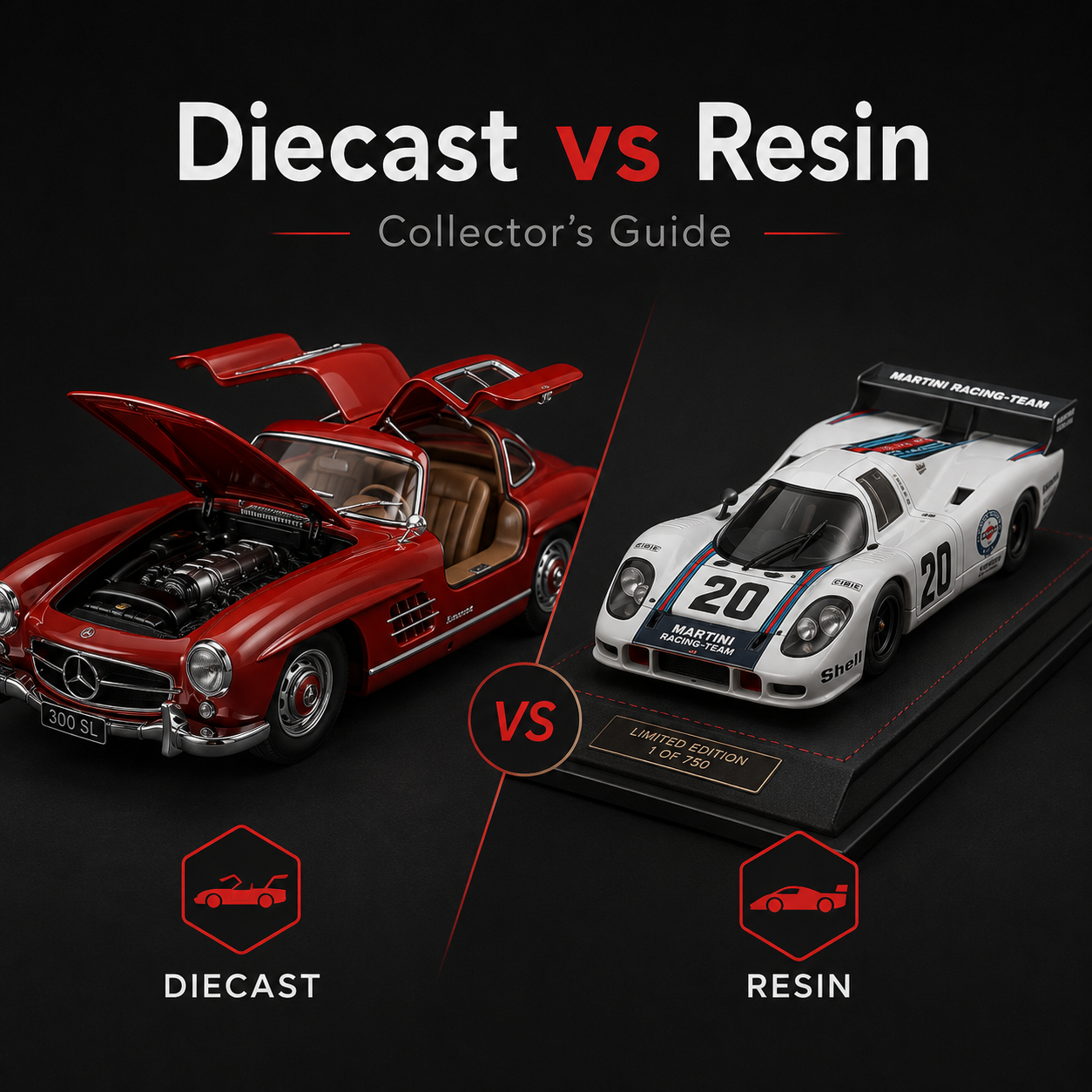
Diecast and resin are the two main construction methods used for modern collectable scale models. Both can produce highly detailed and accurate replicas, but they tend to offer different features, finishes and collecting experiences.
Diecast models are generally associated with metal construction, a reassuring weight and, on some models, opening parts. Resin models are usually sealed and display-focused, allowing manufacturers to recreate more specialised subjects in smaller production runs.
Neither material is automatically better than the other. The right choice depends on the subject, manufacturer, scale, price and the features that matter most to you.

Quick Recommendations
- Choose diecast if you prefer a solid, weighty model, greater durability or opening features.
- Choose resin if you value unusual subjects, precise body shapes and a display-focused finish.
- Choose by manufacturer and model if accuracy is your priority, as quality varies more between individual releases than materials alone.
- Consider both if you collect a particular manufacturer, vehicle, racing team or period rather than one type of construction.
Diecast and Resin at a Glance
| Feature | Diecast Models | Resin Models |
|---|---|---|
| Main material | Cast metal, usually a zinc alloy, with plastic and other components | Synthetic resin with plastic, metal and photo-etched components |
| Weight | Usually heavier | Usually lighter |
| Opening parts | Sometimes included, although many modern diecast models are sealed | Usually sealed with no opening parts |
| Body shape | Can be highly accurate, although opening panels may require visible shut lines and hinges | Well suited to producing clean body shapes and fine exterior details |
| Durability | Generally more robust, although small details can still be delicate | More fragile and best handled carefully |
| Production quantities | Often produced in larger quantities | Often produced in smaller or limited production runs |
| Typical subjects | Popular road cars, competition cars and mainstream releases | Specialist vehicles, rare variations, concept cars and collector-focused subjects |
| Presentation | Varies from window boxes to display bases and premium packaging | Frequently supplied on a display base, sometimes with an acrylic cover |
What Is a Diecast Model?
A diecast model uses a metal casting for a substantial part of its body. The metal is normally a zinc-based alloy which is injected into a mould under pressure, producing a strong and repeatable body shell.
The term diecast does not mean that every part of the model is made from metal. Most diecast models also use plastic, rubber and other materials for components such as:
- interior fittings;
- windows and light lenses;
- grilles and trim;
- wheels and tyres;
- mirrors, aerials and spoilers;
- chassis and engine components.
The amount of metal used varies between manufacturers and ranges. Some models have a metal body and metal base, while others combine a metal outer body with a largely plastic chassis and interior.

What Is a Resin Model?
A resin model is produced by pouring liquid synthetic resin into a mould and allowing it to harden. This method is particularly suitable for smaller production runs because the tooling can be less costly than the heavy metal moulds used for mass-produced diecast models.
Resin models are normally built as sealed display pieces. The main body is formed as a fixed shell, with separate components added for the windows, lights, trim, wheels, interior and other details.
Premium resin models may also include:
- photo-etched metal grilles and fasteners;
- fine window surrounds and badges;
- separate light lenses;
- fabric-effect seatbelts;
- detailed wheels and brake components;
- carefully applied racing liveries and decals.
Many resin models are assembled and finished by hand. This makes the method well suited to specialist subjects, although minor variations between individual examples can sometimes occur.
Detail and Accuracy
Resin is often associated with finer detail, but the material alone does not determine the quality or accuracy of a model. A well-designed diecast model can be more accurate than a poorly researched resin model, and modern manufacturing techniques have significantly improved both types.

Advantages of Resin Construction
Because most resin models are sealed, the manufacturer does not need to engineer working hinges, latches or opening panels. This can help preserve the shape and proportions of the original vehicle.
Resin construction can be particularly effective for reproducing:
- complex curves and bodywork;
- small vents, creases and aerodynamic features;
- thin pillars and window surrounds;
- specialist racing modifications;
- rare body styles and low-production vehicles.
Advantages of Diecast Construction
Diecast models can also achieve an excellent level of exterior and interior detail. Premium diecast releases may include opening panels, detailed engines, carpeted interiors, working suspension or steerable front wheels.
The additional engineering can make the model more interactive, although opening parts may introduce wider panel gaps, visible hinges or slightly thicker components. The significance of this will depend on the model and the collector’s preferences.
Opening Parts and Functional Features
Opening parts were once one of the clearest distinctions between diecast and resin models. However, many modern diecast models are now produced as sealed replicas, particularly where manufacturers have prioritised exterior appearance and affordability.

A diecast model may include:
- opening doors;
- an opening bonnet or engine cover;
- an opening boot or luggage compartment;
- steerable front wheels;
- working suspension;
- removable panels or accessories.
These features are not guaranteed simply because a model is diecast. Product descriptions should always be checked when opening parts are important to you.
Resin models are almost always sealed. Their interiors can still be visible through the windows, but the model is intended to be viewed rather than opened or operated.
Weight and Feel
Diecast models usually feel heavier because of their metal body construction. Some collectors enjoy this substantial feel and associate the weight with traditional model collecting.
Resin models are lighter, although this does not necessarily indicate lower quality. Their value is often found in the quality of the moulding, accuracy, hand finishing, detailed components and limited production rather than the weight of the material.
Weight should therefore be treated as a matter of preference rather than a reliable measure of quality.
Durability and Handling
Diecast models are generally more resistant to handling, but they should still be treated as collectable display models rather than toys. Mirrors, aerials, spoilers, wipers and other small fittings can be delicate regardless of the main body material.

Resin models require greater care. The resin body can crack or chip if dropped, while fine photo-etched or separately fitted parts may bend or detach if touched.
Handling a Diecast Model
- Support the model beneath the chassis rather than lifting it by the roof or spoiler.
- Open moving parts slowly and only as far as intended.
- Avoid forcing doors, bonnets or steering mechanisms.
- Keep fingers away from mirrors, aerials and windscreen wipers.
Handling a Resin Model
- Lift the model by its display base whenever possible.
- Do not lift it by the bodywork, wheels or aerodynamic parts.
- Avoid testing whether parts move unless the manufacturer specifically states that they do.
- Keep the model away from extreme heat, strong sunlight and sudden temperature changes.
Paintwork and Finish
Both diecast and resin models can offer excellent paint finishes. The final result depends on the preparation, painting and quality-control standards used by the manufacturer.
Diecast models commonly use durable painted finishes that are suitable for larger production runs. Resin models are frequently painted and assembled in smaller batches, allowing manufacturers to produce complex colours and liveries for specialist subjects.
Minor imperfections can occur with either construction method. These may include small paint variations, decal alignment differences or traces of hand assembly. Expectations should reflect the manufacturer, range and price point rather than assuming every resin model will have a flawless finish.
Production Runs and Model Choice
Diecast tooling is expensive to develop, making it most economical for models expected to sell in relatively large quantities. This is why popular road cars, Formula 1 cars, supercars and widely recognised classics are often produced in diecast form.
Resin production is better suited to lower quantities. It allows manufacturers to offer models that might not justify the tooling investment required for a large diecast release.
Resin ranges may therefore include:
- rare road cars;
- lesser-known competition cars;
- specific race liveries;
- concept and prototype vehicles;
- coachbuilt or modified cars;
- short-lived vehicle variants;
- models aimed at a specialised collector market.
For collectors following a particular vehicle, racing series or manufacturer, resin may sometimes be the only available option.
Price and Value
Diecast models are available across a very broad price range. Entry-level models may offer simple interiors and limited separate detailing, while premium releases can include complex opening features and extensive hand finishing.

Resin models are often positioned towards the premium end of the market. Their prices can reflect:
- smaller production quantities;
- specialist tooling;
- hand assembly and finishing;
- fine separate components;
- licensed designs and racing liveries;
- premium display bases and packaging.
However, resin does not automatically mean expensive, and diecast does not automatically mean affordable. The manufacturer, scale, licensing, complexity and production quantity all influence the final price.
The best value is the model that offers the subject, accuracy, presentation and features that you personally want from your collection.
Display and Presentation
Resin models are commonly supplied attached to a presentation base. Many premium examples also include a clear acrylic cover and branded outer box. This provides an immediate display solution and helps protect delicate components from dust and accidental contact.
Diecast presentation varies more widely. Depending on the range, a diecast model may be supplied in:
- a basic window box;
- a card-backed blister pack;
- a polystyrene or moulded inner tray;
- a display base with a clear cover;
- a premium presentation box.
Collectors displaying models without covers should allow enough space to clean around them without touching mirrors, aerials or other fragile details.
Which Material Is Best for Different Collectors?

For Collectors Who Prefer Opening Features
Diecast is normally the better starting point, particularly in larger scales such as 1:18. Always check the individual product details, as many modern diecast models are sealed.
For Collectors Who Prioritise Exterior Shape
A sealed resin model can offer particularly clean lines and consistent bodywork. Sealed diecast models can provide similar benefits, so comparisons should be made between individual releases.
For Collectors of Rare Subjects
Resin often provides the widest choice of unusual vehicles, race variations and specialist subjects produced in relatively small quantities.
For Collectors Who Regularly Handle Their Models
Diecast is generally more suitable, although all collectable models contain small parts that can be damaged through frequent handling.
For Collectors Who Prefer Weight
Diecast will usually provide the heavier and more traditional feel associated with metal model cars.
For Display-Cabinet Collectors
Both types are suitable. Resin models are particularly well suited to permanent display, while diecast models offer a wider choice of price points and features.
Does the Scale Make a Difference?
The differences between diecast and resin can become more noticeable at larger scales.
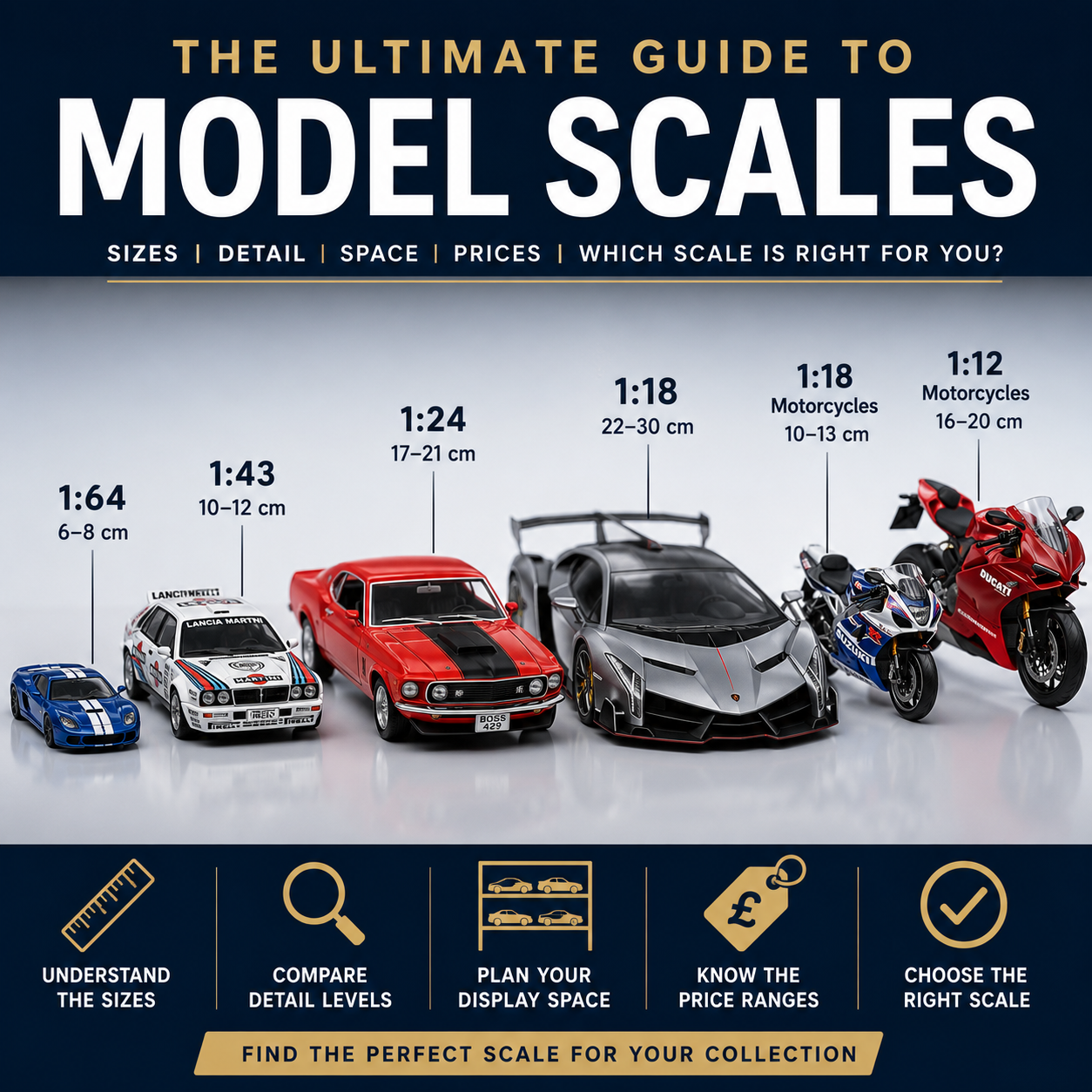
1:64 Scale
Most 1:64 models are diecast because the scale is well suited to higher-volume production. Resin releases exist but are less common and are usually aimed at specialist collectors.
1:43 Scale
Both materials are widely used at 1:43 scale. Diecast provides a broad selection of affordable and mid-range models, while resin is often used for specialist road cars, racing subjects and premium display pieces.
1:24 Scale
Diecast is common at 1:24 scale, particularly among accessible collector ranges. Resin models are available but tend to be less widespread and more specialist.
1:18 Scale
At 1:18 scale, the distinction is particularly noticeable. Diecast models may offer substantial weight and opening parts, while resin models often focus on accurate exterior presentation, limited production and less commonly modelled subjects.
1:12 Scale
Large 1:12 models can be produced in either material. Diecast is frequently used for model motorcycles, while premium resin is often chosen for limited-production cars and highly specialised display models.
Can Diecast and Resin Models Be Displayed Together?
There is no reason to restrict a collection to one material. Diecast and resin models of the same scale can be displayed together, although differences in presentation bases and overall height may need to be considered.
Many collectors organise their displays by:
- vehicle manufacturer;
- model scale;
- motorsport series;
- driver or racing team;
- road-car era;
- country of origin;
- colour or body style.
A mixed-material collection can provide a much broader choice of subjects than limiting the collection exclusively to diecast or resin.
Frequently Asked Questions
Are resin models more detailed than diecast models?
Resin models can reproduce fine exterior shapes and details particularly well, but they are not automatically more detailed. The manufacturer, tooling, research and price point are more important than the material alone.
Are all diecast models made entirely from metal?
No. The main body is normally metal, but plastic, rubber and other materials are commonly used for the chassis, interior, windows, lights and smaller components.
Do all diecast models have opening parts?
No. Many diecast models are sealed. Opening doors, bonnets and boots should only be expected when they are specifically included in the product description.
Why are resin models usually sealed?
Resin is best suited to creating a fixed body shell. Producing reliable hinges and opening panels would add complexity and could reduce the accuracy of the exterior shape.
Why can a lightweight resin model cost more than a heavier diecast model?
Collector-model prices are not based on weight alone. Resin models may be produced in smaller quantities and can involve specialist tooling, hand assembly, fine components and more complex finishing.
Are resin models fragile?
They are generally more delicate than diecast models. The body may chip or crack if dropped, and fine details can be damaged through careless handling.
Which type is better for children?
Collector-grade diecast and resin models are generally intended for adult collectors and are not toys. They may contain sharp points, small parts and delicate components. The stated manufacturer age recommendation should always be followed.
Do resin models retain their value better?
Not necessarily. Future value depends on demand, rarity, condition, subject, manufacturer and production quantity. Neither construction method guarantees that a model will increase in value.
Can resin models develop problems over time?
Resin models should be kept away from excessive heat, strong sunlight and rapid temperature changes. Properly stored examples can remain in excellent condition for many years.
Should I keep the original packaging?
Keeping the original box, display base, fixing screws and protective packaging is advisable. It provides safer storage and transport and may also be important to another collector if the model is sold in the future.
Final Thoughts
Diecast and resin models offer different advantages rather than representing different levels of collectability.
Diecast models are usually heavier and more robust, with some ranges offering opening parts and functional features. Resin models are normally sealed, more delicate and particularly well suited to detailed specialist subjects produced in smaller quantities.
The most important considerations are the quality of the individual model, the reputation of the manufacturer and how well the release meets your collecting priorities.
Diecast offers weight, durability and potential opening features. Resin offers specialist subjects, clean body shapes and display-focused presentation. Both can form an equally valuable and enjoyable part of a scale model collection.

Partager:
Ultimate Guide to Diecast Model Scales